Electric furnace cost: what installation runs in 2026
An electric furnace costs $3,000 to $6,500 installed. The panel and circuit are the swing factors, and resistance heat costs more to run than gas.
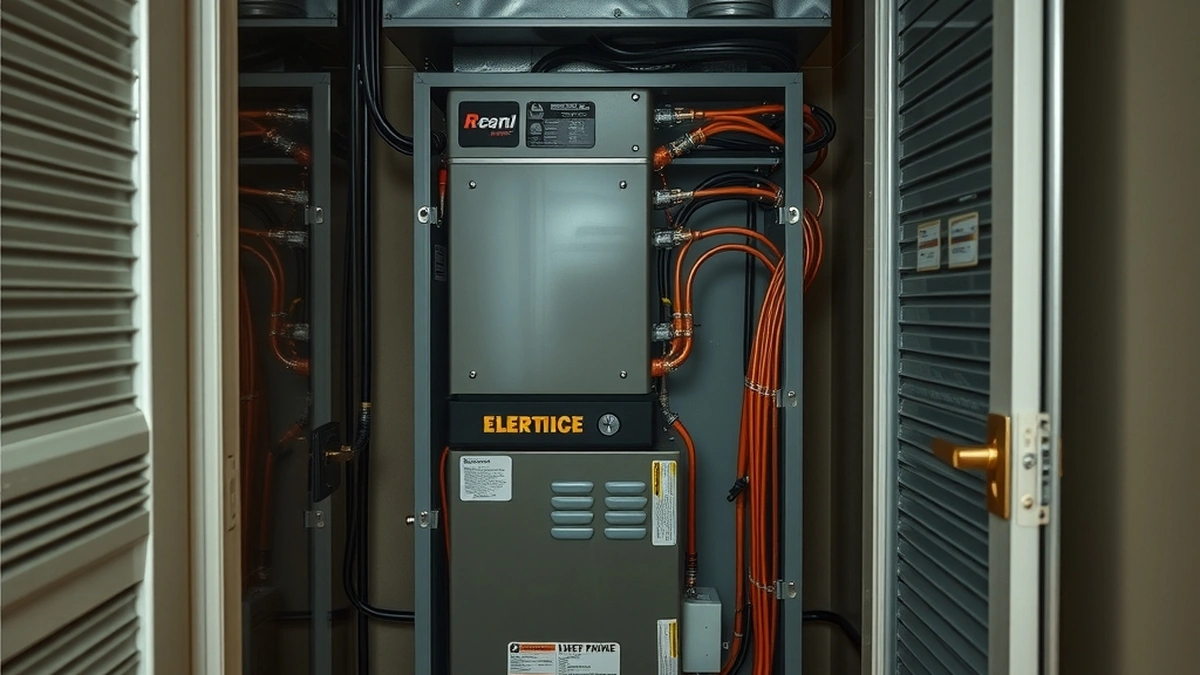
An electric furnace costs $3,000 to $6,500 installed, usually below the $3,000 to $8,000 band for gas. A new 240-volt circuit or panel upgrade adds the most. Running cost is higher: resistance heat draws about 29.3 kWh per therm of delivered heat.
- Installed cost
- $3,000 - $6,500
- Dedicated circuit
- $350 - $800
- Repair
- $150 - $600
- Tune-up
- $100 - $250
Some links on this page are affiliate links.If you buy through them we may earn a commission at no extra cost to you. We do not accept payment for rankings. Read the full disclosure.
An electric furnace costs $3,000 to $6,500 installed, usually at the lower end of the $3,000 to $8,000 band that covers furnace replacement generally. The equipment is cheaper than a gas furnace; the electrical work is what varies. A dedicated 240-volt circuit is mandatory, and a service panel that cannot carry the load is the most expensive surprise in the job.
An electric furnace is a forced-air heater that passes current through resistance elements and uses a blower to move the heated air through ductwork. There is no burner, no flue, and no gas line. That simplifies the install and concentrates the cost in the electrical supply.
Where the money goes
| Line item | Typical estimate | What drives it |
|---|---|---|
| Furnace and elements | $1,400–$2,400 | Output in kW, element count, blower |
| Labor and commissioning | $700–$1,700 | Access, panel distance, crew |
| Dedicated 240-volt circuit | $350–$800 | Run length, conduit, wire size |
| Breaker and disconnect | $100–$300 | Amperage, panel type |
| Plenum and duct transition | $250–$700 | Duct size and access |
| Permit and inspection | $100–$350 | Local fee schedule |
| Removal and disposal | $100–$250 | Weight and access |
Low ends: $1,400 + $700 + $350 + $100 + $250 + $100 + $100 = $3,000. High ends: $2,400 + $1,700 + $800 + $300 + $700 + $350 + $250 = $6,500.
A panel upgrade is not in that table because it is not always needed. When it is, budget $1,500 to $3,000 for a 200-amp service change, and treat it as an electrical project rather than a furnace line item.
The panel is the wildcard
An electric furnace is the largest single electrical load in a house. A 15-kilowatt unit draws 62.5 amps at 240 volts. Add an electric range, a dryer, and a water heater on a 100-amp service and the load calculation fails.
The electrician runs a service calculation using the nameplate rating and the existing appliances. If the panel has spare capacity, the job is a breaker and a circuit. If it does not, the choice is a panel upgrade, a smaller furnace, or a different heat source.
This is why two quotes for “an electric furnace” can differ by $3,000. One includes a service upgrade and one assumes the panel is fine. Ask which assumption is in writing.
Electric against gas on the monthly bill
Installation is the smaller number. Over 15 years, fuel dominates.
| Electric resistance | Natural gas at 80 AFUE | |
|---|---|---|
| Cost per unit | $0.16 per kWh (example) | $1.20 per therm (example) |
| Units per therm of heat | 29.3 kWh | 1.25 therms of input |
| Cost per therm delivered | $4.69 | $1.50 |
The arithmetic: one therm is 100,000 BTU, and 29.3 kilowatt-hours equals 100,000 BTU. At 16 cents, 29.3 × $0.16 = $4.69 per therm. Gas at $1.20 per therm and 80 percent AFUE costs $1.20 ÷ 0.80 = $1.50 per therm delivered.
That is a ratio of $4.69 ÷ $1.50 = 3.1 to one. On 600 therms of annual heat, gas costs 600 × $1.50 = $900 and resistance costs 600 × $4.69 = $2,814. The difference is $1,914 a year, which is most of a replacement furnace every three years.
A heat pump changes that arithmetic because it moves heat instead of making it, which is why our heat pump cost guide puts installed cost at $5,000 to $12,000 and running cost well below resistance.
What pushes the price up
- A long circuit run. Wire and conduit are priced by the foot, and a furnace in an attached garage may be 60 feet from the panel.
- A finished ceiling or basement. Fishing a circuit through finished space takes time.
- A panel replacement. Age, brand, and available spaces decide whether a breaker is enough.
- A larger kW unit. More elements mean a bigger breaker, larger wire, and sometimes a service upgrade.
- Duct changes. An electric furnace is often wider than the gas unit it replaces, so the plenum gets rebuilt.
- A condensate path. Not needed for the furnace itself, but needed if a coil sits above it.
Six steps before you buy
- Get a load calculation for the house, not a copy of the old furnace’s kW rating.
- Ask for the service calculation in writing, including the existing appliances counted.
- Confirm the breaker and wire size against the nameplate amps, at 125 percent.
- Compare kW, not “BTU equivalent”. A 15 kW furnace delivers about 51,000 BTU per hour; the conversion is kW × 3,412.
- Check whether the plenum and filter grille can handle the airflow the new blower produces.
- Confirm the permit covers the electrical circuit, not just the appliance swap.
When electric is the right answer
Electric resistance is the right choice when there is no gas service and a heat pump is not viable, when the furnace is a backup for a heat pump, or when the space is small and the electrical capacity already exists. It is also common in apartments and in regions with cheap hydroelectric power.
It is the wrong choice when gas is available and the annual heating load is large. The install saving disappears in the first two winters. For the full comparison, see the electric versus gas guide, and for the installation sequence, the installation guide.
Frequently asked questions
How much does an electric furnace cost installed?
Three thousand to six thousand five hundred dollars for a typical house, including the unit, a dedicated 240-volt circuit, the plenum, and a permit. A panel upgrade can add one thousand five hundred to three thousand.
Is an electric furnace cheaper than a gas furnace?
Cheaper to install, usually by several hundred to two thousand dollars. More expensive to run in most US markets, because resistance heat uses about 29.3 kilowatt-hours per therm against gas at roughly a third of that cost per unit of heat.
How many amps does an electric furnace need?
A 10-kilowatt unit draws about 42 amps at 240 volts and needs a 60-amp breaker. A 15-kilowatt unit needs an 80-amp breaker, and a 20-kilowatt unit about 110 amps, sized at 125 percent of nameplate current.
Do I need a new electrical panel for an electric furnace?
Not always. A load calculation decides whether the existing service can carry the furnace plus the range, dryer, and water heater. A 100-amp panel in an all-electric house often cannot, and a 200-amp upgrade is the fix.
How long does an electric furnace last?
Fifteen to twenty-five years, longer than a gas furnace in many cases because there is no combustion, no flue, and no heat exchanger to crack. Elements and sequencers are the parts that fail.
Why is my electric bill so high after installing an electric furnace?
Resistance heat is efficient at the element but expensive per unit of heat. A 15-kilowatt furnace running 200 hours a month uses 3,000 kilowatt-hours, which at 16 cents is four hundred and eighty dollars for that month alone.
Sources
Some links are affiliate links.If you buy through them we may earn a commission at no extra cost to you. We do not accept payment for rankings. Read the full disclosure.