Gas furnace cost: what a replacement runs in 2026
A gas furnace costs $3,000 to $8,000 installed. Here is the line-by-line arithmetic, the efficiency premium, and when repair beats replacement.
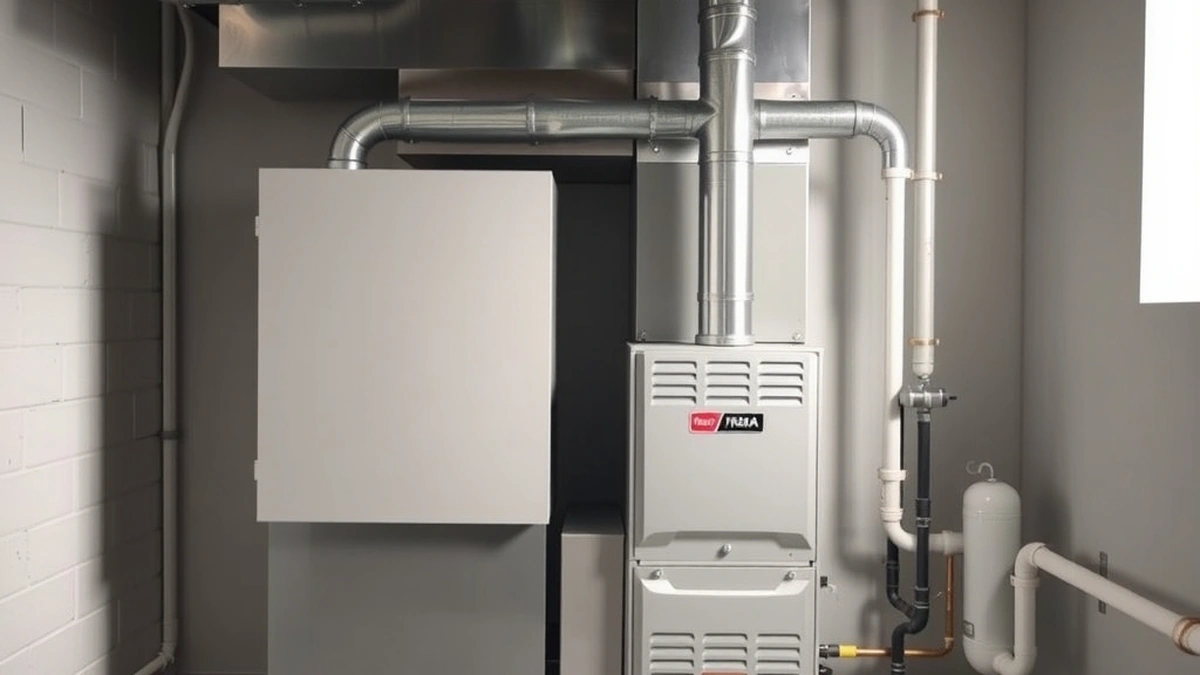
A gas furnace costs $3,000 to $8,000 installed in the US, and most homes land between $4,500 and $6,500 for an 80 percent unit. High-efficiency condensing models add $800 to $2,000. Repair runs $150 to $600, an emergency call-out $200 to $500, and a tune-up $100 to $250.
- Replacement, installed
- $3,000 - $8,000
- Typical mid-range job
- $5,200
- Repair
- $150 - $600
- Annual tune-up
- $100 - $250
Some links on this page are affiliate links.If you buy through them we may earn a commission at no extra cost to you. We do not accept payment for rankings. Read the full disclosure.
A gas furnace costs $3,000 to $8,000 installed in the US, and most single-family homes land between $4,500 and $6,500 for an 80 percent unit that reuses existing ductwork. The appliance is the smallest part of that spread. Venting, gas piping, the plenum, and labor are what separate a $3,200 quote from a $7,800 one.
A gas furnace is a forced-air appliance that burns natural gas or propane in a heat exchanger and pushes warmed air through ductwork. Every line in the price follows from that sentence: combustion needs a flue, the flue needs a route out of the building, and the blower needs ducts that can take its pressure.
What the installed price is made of
| Line item | Typical estimate | What drives it |
|---|---|---|
| Furnace appliance | $1,500–$3,000 | Output in BTU, stages, AFUE |
| Labor and commissioning | $800–$2,200 | Access, hours, crew size, region |
| Venting and flue work | $150–$800 | Existing chimney, liner, or PVC sidewall |
| Gas line, valve, sediment trap | $100–$500 | Pipe size, distance from the meter |
| Plenum and duct transition | $250–$700 | Duct size, static pressure, transitions |
| Permit and inspection | $100–$400 | Local fee schedule |
| Removal and disposal | $100–$400 | Weight, stairs, condition of the old unit |
Low ends: $1,500 + $800 + $150 + $100 + $250 + $100 + $100 = $3,000. High ends: $3,000 + $2,200 + $800 + $500 + $700 + $400 + $400 = $8,000.
That is the whole band in one line of arithmetic. A $3,000 quote is a straight swap with a reused flue and no duct changes. An $8,000 quote usually carries a new vent route, a rebuilt plenum, and a two-stage unit.
High efficiency is a second price
An 80 percent AFUE furnace turns 80 cents of every dollar of gas into heat. A condensing unit at 95 percent turns 95 cents. For the same delivered heat the input falls by the ratio 80 ÷ 95 = 0.842, which is a 15.8 percent cut in fuel.
On a $1,400 annual gas bill that is $1,400 × 0.158 = $221 a year. A condensing furnace typically adds $800 to $2,000 to the install. At a $1,500 premium, $1,500 ÷ $221 = 6.8 years to break even, before any repair on the more complex unit.
Condensing furnaces also produce acidic condensate that must drain, and they vent through PVC rather than a metal flue. If there is no drain path near the furnace, that is extra work rather than a free upgrade.
What pushes a quote toward $8,000
- A masonry chimney that needs a liner. A new furnace cannot share an unlined flue with a water heater in most cases.
- Duct static pressure. Undersized returns starve a modern blower, so a return or a rebuilt plenum gets added.
- Access. A closet, attic, or crawlspace unit takes longer to remove and set than a basement unit on a pad.
- Gas line capacity. A long run from the meter may need a larger pipe, a new shutoff, and a sediment trap.
- Two-stage or modulating controls. The appliance costs more, and so does the thermostat wiring.
- A new electrical circuit. Condensate pumps, humidifiers, and electronic air cleaners all need power that may not be there.
Gas furnace against the alternatives
| Gas furnace | Electric furnace | Heat pump | Boiler | |
|---|---|---|---|---|
| Installed | $3,000–$8,000 | $3,000–$6,500 | $5,000–$12,000 | $4,000–$8,000 |
| Fuel | Natural gas or propane | Electricity | Electricity | Gas, oil, propane |
| Cooling | Needs separate AC | Needs separate AC | Included | Needs separate system |
| Distribution | Ducted air | Ducted air | Ducted air | Water and radiators |
The heat pump and boiler columns come from our heat pump cost guide and boiler cost guide. A house that already has ducts has most of the gas furnace’s infrastructure paid for, which is why the like-for-like swap usually wins on price.
Repair or replace, in dollars
A repair runs $150 to $600. An emergency call-out adds $200 to $500 in many markets, and that is before parts. The decision rule is arithmetic, not sentiment.
Take a 13-year-old furnace with a $480 repair. If that repair buys three more years, the cost is $480 ÷ 3 = $160 a year. Replacement at $5,200 over a 15-year service life is $5,200 ÷ 15 = $347 a year. Repair wins.
Now take a 20-year-old unit with a cracked heat exchanger. That is not a repair, it is a replacement, because the part is the safety barrier between flue gas and the air you breathe. At 20 years, replacement is also cheaper per year of service.
Six steps before you sign
- Ask for a load calculation. A Manual J report sizes the furnace to the house, not to the old label. Copying 100,000 BTU forward is how oversizing propagates.
- Get the model number in writing. AFUE, stages, and blower type live in the model number, not in the word “efficiency” on a proposal.
- Confirm the venting plan. Chimney liner, existing flue, or PVC sidewall, with the parts listed separately.
- Ask what happens to the plenum and the first duct run. A transition that necks down costs airflow and noise.
- Compare three quotes on identical scope. The lowest number on different scope is not a lower price.
- Confirm the permit and the combustion test. A printed combustion analysis at commissioning is the proof the install is right.
The annual number that outlasts the install
Installation is one payment. Fuel runs every winter for 15 to 20 years, and maintenance is $100 to $250 a year for a tune-up and safety check. A skipped tune-up is how a $180 service becomes a $600 repair, and our maintenance guide covers what the visit includes.
If the ducts have never been cleaned, budget $300 to $800 as a separate job, and only when there is visible debris or a renovation history. Our installation guide walks through the day-by-day process, and furnace repair near me explains how to find a contractor who puts scope in writing.
Frequently asked questions
How much does a gas furnace cost installed?
Three thousand to eight thousand dollars, with most single-family homes between four thousand five hundred and six thousand five hundred for an 80 percent unit that reuses the existing flue and ductwork.
Is a high-efficiency gas furnace worth the extra money?
It is where the flue and condensate drain can be routed without major work. The premium is roughly eight hundred to two thousand dollars, and the fuel saving is about 15 to 16 percent against an 80 percent unit.
How long does a gas furnace last?
Fifteen to twenty years with an annual tune-up. Heat exchangers usually decide the end of life, and a cracked exchanger means replacement rather than repair because it is the barrier between flue gas and room air.
Should I repair or replace a 15-year-old furnace?
Repair if the quote is under about a third of replacement and the unit has not had a heat exchanger failure. Past 18 years, or with a cracked exchanger, replacement is cheaper per year of service.
Does a new furnace increase home value?
A documented, permitted, warrantied installation helps at inspection and negotiation. It rarely returns its full cost in appraisal value, so treat it as comfort, safety, and reliability spending.
What is the cheapest way to replace a gas furnace?
A straight swap that reuses the flue, gas line, and plenum, done in the shoulder season by a contractor with a crew already in the area. Cheapest still means permitted and commissioned, not unpermitted.
Sources
Some links are affiliate links.If you buy through them we may earn a commission at no extra cost to you. We do not accept payment for rankings. Read the full disclosure.