How much does furnace repair cost?
Furnace repair in the US runs $150 to $600, with a typical bill near $350. See what each repair type costs and how the total is built.
Furnace repair costs $150 to $600 in the US, with most single-fault jobs landing near $350 for a part plus labor. Emergency call-outs add $200 to $500, and full replacement runs $3,000 to $8,000.
- Typical furnace repair range
- $150–$600
- Tune-up and safety check
- $100–$250
- Emergency call-out
- $200–$500
- Full furnace replacement
- $3,000–$8,000
Some links on this page are affiliate links.If you buy through them we may earn a commission at no extra cost to you. We do not accept payment for rankings. Read the full disclosure.
Furnace repair in the US typically costs $150 to $600, and most single-fault jobs land near the middle of that band at roughly $300 to $400. The total moves with the part that failed, the hours the job needs, and whether you called during a cold snap. A quote well above $600 should come with a written explanation of what makes the job unusual.
What the $150–$600 range actually buys
Furnace repair is the diagnosis and correction of a specific fault in the heating unit, its controls, or its venting. It is not routine maintenance. A tune-up and safety check is a separate service that runs $100 to $250 and covers cleaning, combustion testing, and verification of the safety switches.
At the bottom of the repair range you get one inexpensive part and under an hour of labor: a flame sensor cleaned, a thermostat swapped, a capacitor replaced. At the top you get a blower motor, a draft inducer, or a control board, plus the two to four hours it takes to fit, wire, and test them.
Typical prices by repair type
The table below is built from parts pricing plus standard residential labor rates of roughly $75 to $150 per hour, which is the band most US HVAC shops publish. Treat every row as an estimate for a straightforward swap, not a fixed quote.
| Repair | Typical cost | Usual labor time |
|---|---|---|
| Flame sensor clean or replace | $150–$250 | 30–60 min |
| Hot surface igniter | $200–$350 | 45–90 min |
| Thermostat replacement | $150–$300 | 30–60 min |
| Pressure switch | $200–$350 | 45–90 min |
| Draft inducer motor | $350–$600 | 1.5–3 hours |
| Blower motor | $400–$600 | 2–4 hours |
| Control board | $350–$600 | 1–2 hours |
| Condensate line clearing (high-efficiency) | $150–$250 | 30–60 min |
A draft inducer that lists at $220 and takes 1.5 hours at $110 per hour comes to $385 — inside the range and typical of that job. A blower motor at $300 plus three hours at $100 is $600, which is why that repair sits at the ceiling.
What drives the bill
Three inputs set the price: the part, the hours, and the call itself.
- Part cost. Igniters and sensors are cheap and stocked on most trucks. Motors and boards are not, and an older unit may need a part ordered in, which adds a second visit and a second trip charge.
- Access. A furnace in a closet off a hallway comes apart quickly. The same unit wedged into a crawlspace behind a water heater can double the labor hours.
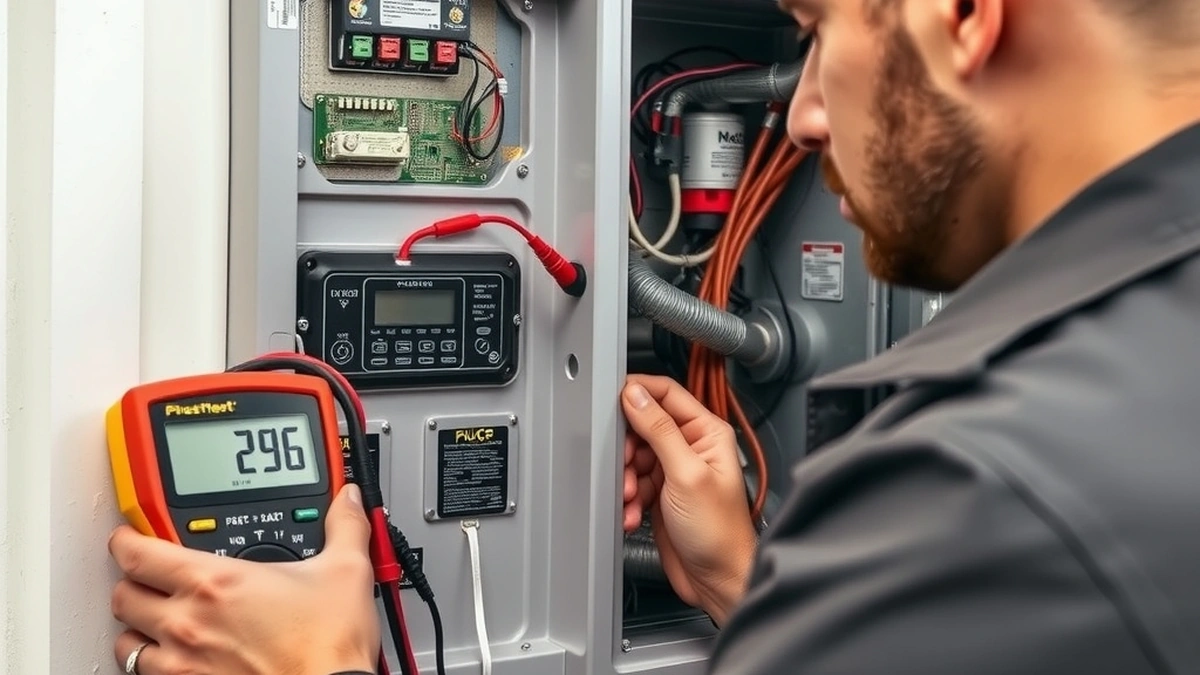
- Diagnosis time. A proper visit starts with 20 to 40 minutes of testing: reading fault codes, measuring temperature rise across the heat exchanger, checking gas pressure, and verifying voltage at the board.
Diagnostic fees of $75 to $150 are common. Many shops credit the fee against the repair if you approve the work on the spot, so ask which policy applies before anyone opens the panel. Our furnace inspection guide covers what that diagnostic step should include.
Emergency and after-hours premiums
An emergency call-out adds $200 to $500 on top of the repair, covering the trip, a premium labor rate, and the fact that someone is working at 11 p.m. in January.
Run the arithmetic on a mid-winter failure: a $180 igniter, one hour of labor at $110, and a $250 emergency fee totals $540. The identical job at 10 a.m. on a Tuesday is $290. The $250 gap buys warmth tonight. If the house is safe and above freezing, it buys nothing else.
Repair or replace
| Repair | Replace | |
|---|---|---|
| Cost today | $150–$600 | $3,000–$8,000 |
| What it covers | One failed component | Whole unit, new parts warranty |
| Sensible when | Unit under 15 years old, one fault | Unit 15+ years old, second major failure |
| Annualized cost | Depends on remaining life | $200–$533 per year over 15 years |
The annualized column is where the decision usually turns. A $3,000 replacement spread over 15 years of service is $200 a year. An $8,000 replacement over the same span is $533 a year. A $500 repair on a furnace with three winters left works out to $167 a year, which is cheaper — until the next repair arrives in eight months.
Five steps to get an accurate number
- Write down the symptom and the model number. “Short-cycles after four minutes” plus the data plate details saves the technician diagnostic time, and some shops price accordingly.
- Check the filter, the breaker, and the thermostat batteries first. A clogged filter or a tripped switch accounts for a share of no-heat calls that cost nothing to fix.
- Book a standard appointment if the house is safe. The emergency premium is real money for the same work.
- Ask whether the diagnostic fee is credited against the repair, and get the answer before the visit.
- Request the quote in writing with part numbers, labor hours, and the warranty length on both the part and the labor.
When a price should make you stop
A quote that is far below the range deserves the same scrutiny as one that is far above it. Our guide to cheap furnace repair explains what low bids leave out, usually diagnostics and safety verification.
It also helps to know what you are not buying. Duct cleaning runs $300 to $800 and is a separate service from a repair. A heat pump installation runs $5,000 to $12,000 and is a different project entirely. If either shows up on a repair invoice without a clear reason, ask why.
Electrical faults are the area where pricing varies most, because tracing a short or a bad ground can take an hour or three. Our electric furnace repair article covers what that diagnostic work looks like on an electric unit. If you are still deciding whether to spend the money at all, the repair versus replacement math is the next thing to read.
The short version: budget $350 for a normal repair, treat $600 as the realistic ceiling, and question anything above it until the invoice explains itself.
Frequently asked questions
How much does the average furnace repair cost?
Most single-fault repairs fall between $150 and $600, with a typical bill around $350 once a mid-priced part and 1.5 hours of labor are added together.
Is a diagnostic fee extra?
Often yes. Diagnostic fees of $75 to $150 are common, and many contractors credit the fee against the repair if you approve the work that day.
Why is my quote higher than $600?
A quote above $600 usually involves a blower motor, a control board, a heat exchanger, or two visits because a part had to be ordered in.
Does a weekend call cost more?
Yes. After-hours and weekend call-outs add $200 to $500 on top of the repair, covering the trip fee and a premium labor rate.
Should I repair or replace at this price?
Repair usually wins on units under 15 years old with a single fault. Once a second major failure hits an old unit, replacement at $3,000 to $8,000 is often cheaper per year of service.
Can I avoid the emergency fee?
If the house is safe and above freezing, book a standard appointment. The same job during business hours often costs $250 less than an overnight call.
Sources
Some links are affiliate links.If you buy through them we may earn a commission at no extra cost to you. We do not accept payment for rankings. Read the full disclosure.