Short cycling: what a fix costs, cause by cause
Most short-cycling fixes run $150 to $600 including the diagnostic. Here is the arithmetic for each cause, plus the running cost of leaving it alone.
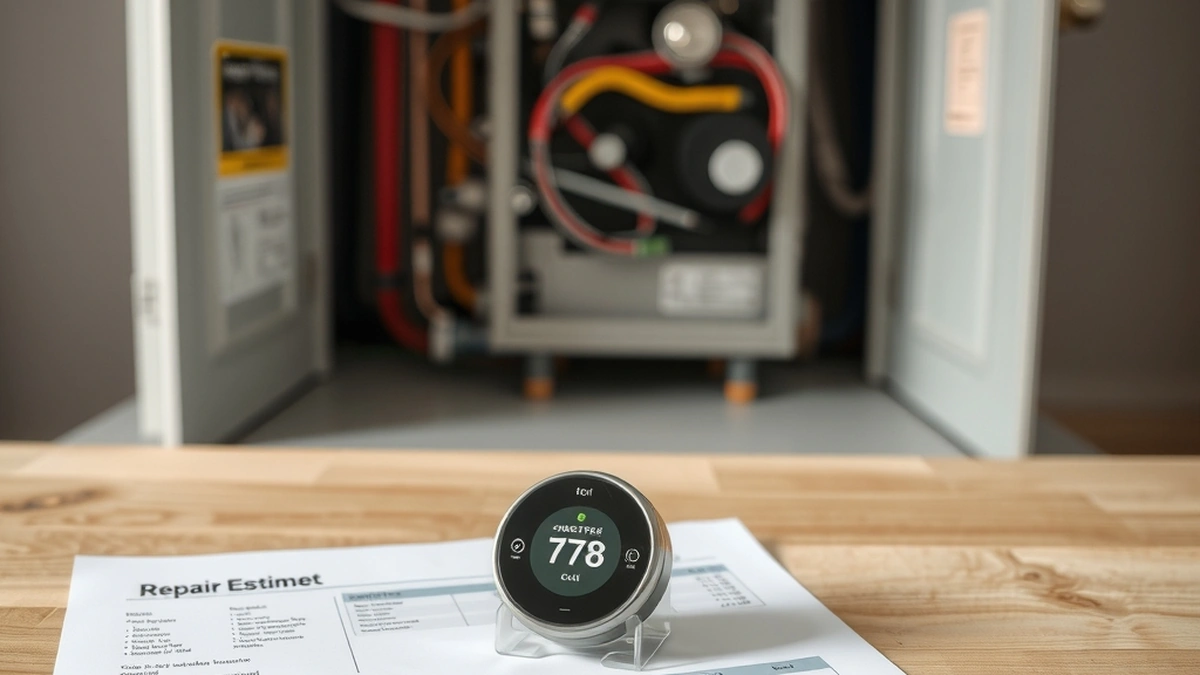
Fixing short cycling usually costs $150 to $600, including a $100 to $250 diagnostic and the part or airflow correction. Refrigerant work on a heat pump lands in the same band; an oversized system cannot be repaired and needs replacement at $3,000 to $8,000.
- Most repairs
- $150 - $600
- Diagnostic visit
- $100 - $250
- After-hours call-out
- $200 - $500
- Furnace replacement
- $3,000 - $8,000
Some links on this page are affiliate links.If you buy through them we may earn a commission at no extra cost to you. We do not accept payment for rankings. Read the full disclosure.
Short cycling usually costs $150 to $600 to fix, and that figure includes the diagnostic visit. The low end is a filter and a thermostat; the high end is a refrigerant leak on a heat pump. The one outcome that is not a repair bill is an oversized system, where the fix is replacement at $3,000 to $8,000 for a furnace or $5,000 to $12,000 for a heat pump.
Pricing this fault is awkward because the symptom is identical across causes that cost very different amounts to fix. That is why the diagnostic matters: it separates a $25 filter from a $500 charge issue.
The diagnostic visit
Expect $100 to $250 for the visit, in line with a furnace tune-up and safety check at the same price. Some companies credit it against the repair, some do not, and the difference is worth asking about before booking.
What you are paying for is measurement, not opinion. A proper short-cycling diagnosis includes temperature rise across the heat exchanger, static pressure in the duct system, thermostat operation, and — on a heat pump — suction and liquid pressures. Those readings are what separate airflow from charge from oversizing.
An after-hours call changes the number: $200 to $500 for the call-out instead of the standard diagnostic.
Cost by cause
The totals below assume a $120 diagnostic and a typical part plus labour. Each is an addition, not a range midpoint.
| Cause | Work | Total with diagnostic |
|---|---|---|
| Clogged filter | Replace filter | $145 |
| Thermostat batteries or relocation | Replace or move | $210 |
| Closed registers, blocked return | Clear, adjust, verify | $180 |
| Return duct restriction | Enlarge or add a return | $420 |
| High-limit switch | Replace switch, verify rise | $290 |
| Dirty blower wheel | Pull and clean | $320 |
| Low refrigerant charge | Leak search plus charge | $500 |
| Defrost control fault | Replace board or sensor | $420 |
Seven of those eight land inside the $150 to $600 band. The exception is a duct modification on a badly designed system, which is a sheet metal job rather than a parts swap and can pass $600 depending on how much duct has to be added.
Three worked examples
A 12-year-old furnace cycling every six minutes. Diagnostic $120, filter $25, total $145. The filter had not been changed in fourteen months. This is the cheapest possible outcome and the most common.
A furnace tripping its high limit with a clean filter. Diagnostic $120, blower wheel pulled and cleaned $200, total $320. The wheel was packed with dust the filter could not catch, airflow was down, and the limit was doing its job.
A heat pump cycling in heating mode. Diagnostic $120, leak search $200, refrigerant charge $180, total $500. The leak was at a flare connection; the repair included a new flare and a charge to spec. A second visit to confirm the charge is sometimes billed separately.
What short cycling actually wastes
The running-cost argument is usually overstated, so here is the honest version with the assumptions on the table.
Every furnace start includes an inducer purge of roughly 30 to 60 seconds. Assume 45 seconds, and assume the fault adds 20,000 extra starts a year:
- 20,000 × 45 seconds = 900,000 seconds = 250 hours of extra inducer runtime.
- An inducer drawing 300 watts uses 250 × 0.3 = 75 kWh.
- At $0.16 per kWh, that is $12 a year.
Twelve dollars is not the reason to fix it. The real costs are these:
- Igniters. A hot-surface igniter is a wear item, and extra starts shorten its life. Replacement runs $150 to $300.
- Inducers and pressure switches. More starts mean more heat cycles on the motor and more switch operations. Replacement runs $400 to $700.
- Heat exchangers. Repeated high-limit trips are thermal stress, and a cracked exchanger ends the furnace.
- Compressors. A heat pump compressor is not designed for dozens of starts a day, and compressor replacement usually costs more than a third of a new system.
Add comfort: a house that cycles never holds an even temperature, and in cooling mode it never runs long enough to remove humidity.
When replacement is cheaper
Run the arithmetic on two scenarios rather than trusting a rule of thumb.
A twenty-year-old furnace with a third repair in two years. Repairs total $1,500 over two years = $750 per year, with no warranty on the rest of the unit. Replacement at $5,500 over eighteen years = $306 per year, plus lower fuel use.
An eight-year-old oversized furnace that cannot be repaired into comfort. Replacement at $5,500 = $306 per year. Fuel improves too: at 90 AFUE against 80 AFUE, the new unit uses 80 ÷ 90 = 89 percent of the gas. On a $1,400 annual bill that saves $1,400 × 0.11 = $154 a year.
A heat pump short cycling on a failed compressor. Replacement at $8,500 over fifteen years = $567 per year. A compressor swap on an eight-year-old system often lands near half that, with no efficiency gain, which is why the age of the rest of the system decides it.
Five ways to avoid paying twice
- Change the filter before you book. A $25 filter can end the call before it starts.
- Ask for temperature rise and static pressure readings on the invoice, not just a diagnosis.
- Get the cause in writing, so a repeat visit for the same symptom is a warranty call rather than a new bill.
- Ask whether the equipment is correctly sized. If the answer is no, stop repairing and price replacement.
- Budget the tune-up. At $100 to $250, it is the cheapest way to catch a limit trip before it becomes a January emergency.
Our guide to short cycling repair options explains what each cause looks like before you call, and no-heat costs covers the pricing if the cycling has already ended in a lockout. If the system is a heat pump rather than a furnace, the heat pump cost guide sets out replacement pricing and the installation guide explains why sizing errors happen in the first place.
Frequently asked questions
How much does it cost to fix short cycling?
Typically $150 to $600 including the diagnostic and the part. Airflow fixes sit at the low end, refrigerant repairs at the high end, and oversizing is not repairable at all.
Is short cycling expensive to ignore?
The wasted fuel is modest, but the wear is not. Repeated starts consume igniters at $150 to $300 and inducers at $400 to $700, and they stress the heat exchanger and compressor.
Why does the diagnostic cost extra?
Short cycling has several possible causes and they cannot be separated without readings. The fee pays for temperature rise, static pressure, and pressure or charge measurements.
Can a $150 repair really fix short cycling?
Sometimes. A filter, a thermostat battery, or a closed return can be the entire cause, and those are the cheapest outcomes. The average bill includes a diagnostic and a part.
When is replacement cheaper than repairing short cycling?
When the equipment is oversized, when repairs pass about a third of replacement cost, or when the same fault returns within a year on a unit past fifteen years.
Does short cycling raise my gas bill much?
Less than most people expect. The real cost is component wear and comfort. A rough purge calculation puts the wasted electricity at roughly $12 a year in a typical example.
Sources
Some links are affiliate links.If you buy through them we may earn a commission at no extra cost to you. We do not accept payment for rankings. Read the full disclosure.