Heat pump vs ductless mini-split
Both are heat pumps; one distributes through ducts, the other through wall heads. Cost, efficiency and which suits your house, with worked numbers.
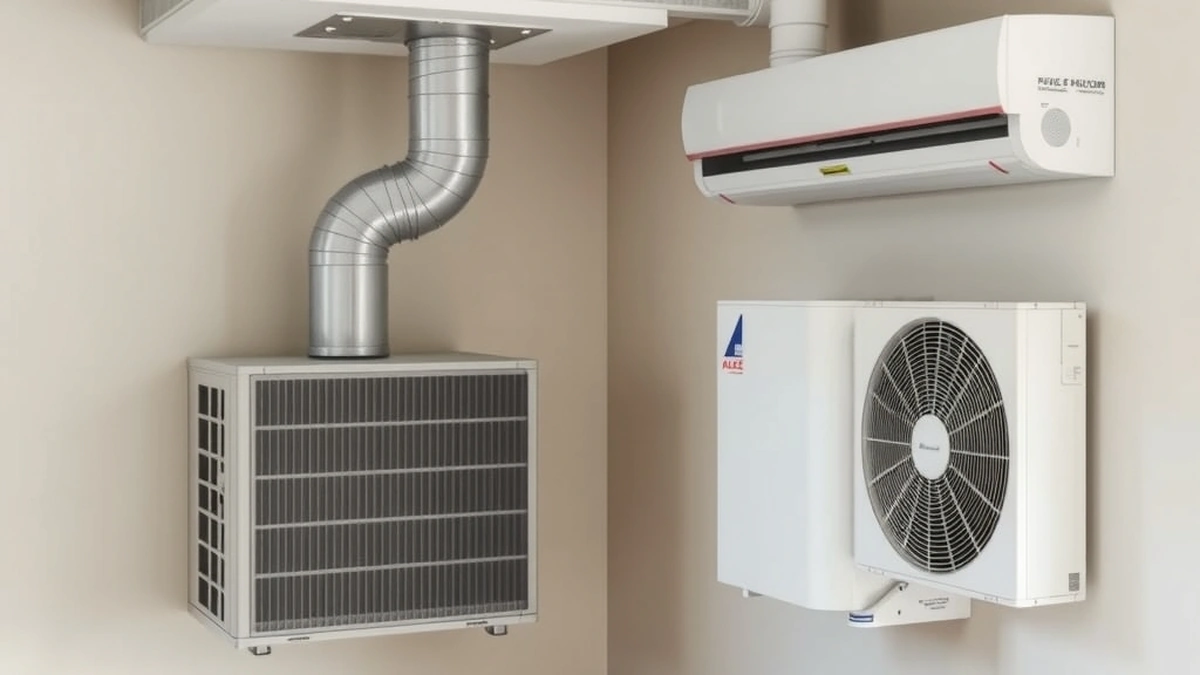
A ducted heat pump costs $5,000 to $12,000 and conditions a whole house through existing ducts. A ductless mini-split costs $3,000 to $5,500 per zone and needs no ducts. Ducted is cheaper per square foot; ductless avoids duct losses and allows zoning.
- Ducted heat pump
- $5,000 - $12,000
- Ductless per zone
- $3,000 - $5,500
- Annual service
- $150 - $300
- Filter care
- Monthly to quarterly
Some links on this page are affiliate links.If you buy through them we may earn a commission at no extra cost to you. We do not accept payment for rankings. Read the full disclosure.
A ducted heat pump costs $5,000 to $12,000 and conditions a whole house through existing ductwork. A ductless mini-split costs $3,000 to $5,500 for the first zone and needs no ducts at all. Both are heat pumps and both heat and cool. The choice turns on whether the house has usable ducts, and whether room-by-room control is worth the extra hardware.
The shared technology
Both systems use the same refrigeration cycle. An outdoor unit moves heat between the outside air and a refrigerant circuit; an indoor unit delivers that heat to the house.
Where they differ is delivery:
- Ducted — a central air handler pushes conditioned air through ducts to registers.
- Ductless — one or more wall, ceiling or floor heads deliver air directly into a room.
The efficiency of the refrigeration cycle is similar. The efficiency of the system differs, because ducts lose energy and heads do not.
Cost compared
| Item | Ducted heat pump | Ductless mini-split |
|---|---|---|
| First zone / whole house | $5,000 - $12,000 | $3,000 - $5,500 |
| Additional zones | Included | $1,300 - $2,600 each |
| Ductwork | Existing, or $4,000 - $12,000 | None |
| Line set and electrical | Included | Included per zone |
| Permit | $50 - $500 | $50 - $500 |
| Cooling | Included | Included |
The comparison depends entirely on the starting point. With good ducts, a ducted system is the cheapest way to condition a whole house. Without ducts, a ducted retrofit at $4,000 to $12,000 for ductwork plus the equipment usually exceeds a multi-zone ductless system.
Duct losses, the hidden difference
A ducted system can lose a significant share of its conditioned air to leaks and to conduction through duct walls in unconditioned space. Ducts in a vented attic or a crawlspace are the worst case; ducts inside the conditioned envelope lose much less.
Ductless systems have no such loss. Every Btu delivered to the head reaches the room.
That is why a ductless system with a slightly lower rated efficiency can outperform a ducted system with a higher rating in a house where the ducts run through a hot attic. The rating is measured at the equipment, not at the register.
Sealing and insulating ducts at $800 to $2,500 closes much of the gap, and it is often the cheapest efficiency upgrade in a ducted house.
Zoning and control
A ducted system usually has one thermostat and one temperature for the whole house. Zoning dampers can be added, but they are an extra cost and an extra failure point.
A ductless system is zoned by design. Each head has its own setpoint, so a bedroom can be cooler than a living room without any ductwork changes.
The value of that depends on occupancy. A household that uses every room evenly gains little. A household that heats one wing in the evening gains a great deal.
Running cost, with arithmetic
Assume a house needing 60 million Btu of delivered heat, electricity at $0.16 per kWh, and an average COP of 2.5.
Ducted, with 15 percent duct loss:
- Delivered at the equipment: 60 ÷ 0.85 = 70.6 million Btu
- Electricity: 70.6 ÷ 2.5 = 28.2 million Btu = 8,270 kWh
- Cost: 8,270 × $0.16 = $1,323
Ductless, no duct loss:
- 60 ÷ 2.5 = 24 million Btu = 7,030 kWh
- Cost: 7,030 × $0.16 = $1,125
The difference is $198 a year on those assumptions. It is real but modest, and it is smaller than the difference zoning can make in a partly occupied house.
Where each one wins
Ducted:
- Good existing ductwork in the conditioned envelope.
- Whole-house conditioning at the lowest installed cost.
- Filtration and humidity control through the duct system.
- Fewer visible indoor units. Registers are less obtrusive than wall heads.
- One system to maintain, not several.
Ductless:
- No ductwork, or ductwork that cannot be extended.
- Room-by-room control.
- Additions, garages and converted spaces.
- No duct losses, particularly with ducts in unconditioned space.
- Quiet operation in the conditioned room.
- Smaller individual units, which can be added incrementally.
Maintenance and repair
| Task | Ducted | Ductless |
|---|---|---|
| Annual service | $150 - $300 | $150 - $300 per system |
| Filter care | 1 - 3 months | Monthly rinse per head |
| Duct cleaning | Every few years, $300 - $800 | Not applicable |
| Typical repair | $200 - $800 | $200 - $800 |
| Outdoor unit care | Clear snow and debris | Clear snow and debris |
Ductless heads need their filters rinsed monthly, which is a homeowner task. A ducted system needs periodic duct cleaning at $300 to $800, which offsets some of the maintenance advantage.
Repair costs are similar because the outdoor equipment is the same. The indoor side is simpler on a ductless head but there are more of them.
The cost detail is in heat pump cost and ductless mini-split cost.
What to ask before choosing
- What condition are the ducts in, and where do they run?
- How many rooms need independent control?
- Is there space for an air handler and for outdoor units?
- What is the design heat load?
- What is the whole-house installed cost, not per head?
- Can the two be combined for problem rooms?
Question six is often the practical answer. A ducted system for the main house plus one head for an addition is frequently cheaper than either system alone.
The wider set includes gas furnace vs ductless mini-split and boiler vs ductless mini-split.
Both are heat pumps; only the delivery differs. Ducted is cheaper per square foot when ducts exist and are in good condition. Ductless avoids duct losses, zones by design and suits houses without ducts.
If the ducts are tight and inside the envelope, go ducted. If they are leaky, in an attic, or absent, go ductless.
Frequently asked questions
Is a ducted or ductless heat pump better?
Ducted is better if the house already has good ductwork and needs whole-house conditioning. Ductless is better where there are no ducts, where zoning matters, or where duct losses would be significant.
Which is more efficient?
Ductless, in most installations, because there are no duct losses. A ducted system in a vented attic can lose a meaningful share of its output before the air reaches the room.
How much does each cost installed?
A ducted whole-house heat pump is $5,000 to $12,000. A ductless system is $3,000 to $5,500 for the first zone, with additional heads at $1,300 to $2,600 each.
Can I mix ducted and ductless?
Yes, and it is common. A ducted unit can serve the main living areas while one or two heads cover an addition, a garage conversion or a room the ducts do not reach.
Which is quieter?
Ductless heads are generally quieter at low fan speed, and there is no duct rumble. A well-installed ducted system with a variable-speed air handler is also quiet, but the ductwork is an additional noise path.
Do both provide cooling?
Yes. Both are heat pumps and both heat and cool. That is a shared advantage over a furnace or boiler.
Sources
Some links are affiliate links.If you buy through them we may earn a commission at no extra cost to you. We do not accept payment for rankings. Read the full disclosure.