When to Replace a Furnace: Age, Cost, and Safety Guide
Learn when to replace a furnace based on age, repair history, heat exchanger condition, and operating costs versus installing a new heating unit.
Data checked November 2026 · Sources: manufacturer installation manuals; AHRI efficiency directory; NFPA 54 as locally adopted; local mechanical permit offices ·Methodology →
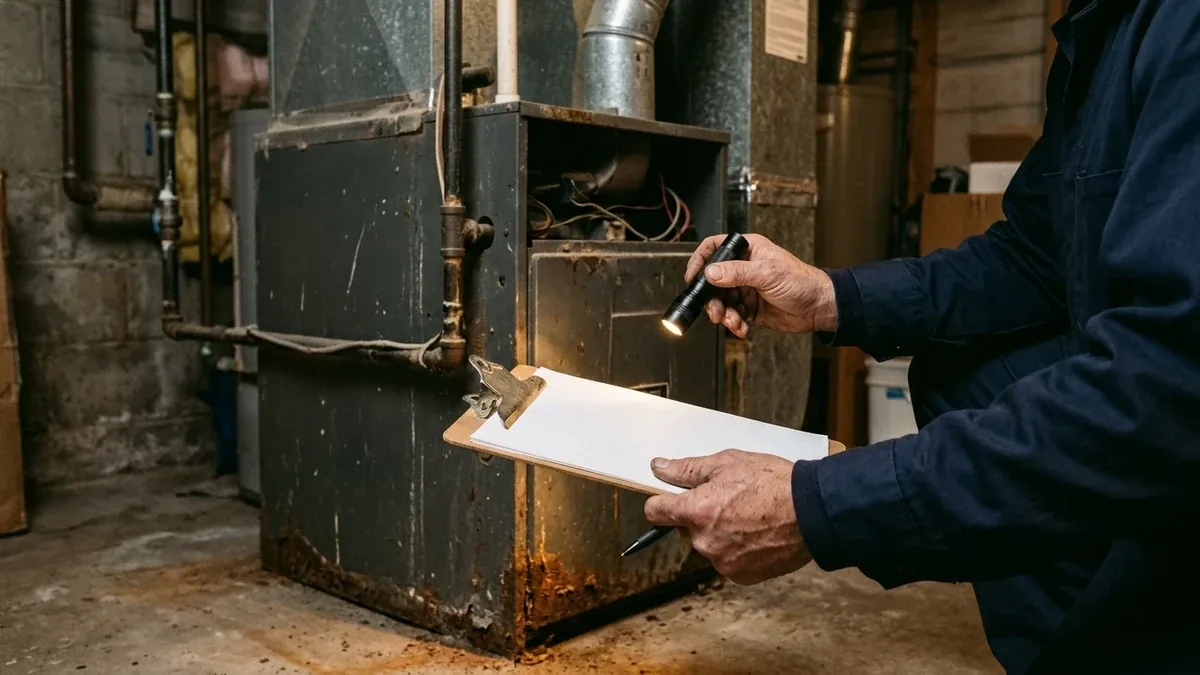
Replace a furnace when it reaches 15 to 20 years of age, suffers a cracked heat exchanger, or requires frequent repairs. While tune-ups run $100 to $250 and minor repairs cost $150 to $600, full replacement ranges from $3,000 to $8,000 installed.
- Typical lifespan
- 15–20 years
- Charted life expectancy
- 15–25 years
- Replacement cost
- $3,000–$8,000
- Minor repair cost
- $150–$600
- Heat pump alternative
- $5,000–$12,000
Some links on this page are affiliate links.If you buy through them we may earn a commission at no extra cost to you. We do not accept payment for rankings. Read the full disclosure.
| Keep the furnace | Replace it | |
|---|---|---|
| Age | Under 15 years | 15-20 years or more |
| Repair pattern | One repair at $150-600 | Repeat repairs approaching a new unit |
| Heat exchanger | Intact, verified by inspection | Cracked: replace, do not repair |
| Parts | Available from the manufacturer | Obsolete or long lead times |
| Efficiency | Existing AFUE still acceptable | Upgrade cuts fuel use and improves comfort |
| Best for | An otherwise sound system | Safety or reliability at risk |
A furnace replacement is the complete removal of an existing heating unit and the installation of new equipment connected to the home ductwork. Deciding whether to keep maintaining older equipment or invest in a new installation requires weighing equipment age, mechanical condition, and safety concerns. Understanding the exact mechanical boundaries helps homeowners avoid unnecessary expenditures while protecting household heating reliability throughout the coldest months of the year. Knowing precisely when to transition saves money and prevents midwinter emergencies.
The five core inputs for replacement decisions
Deciding when to retire heating equipment requires evaluating five specific operational factors: system age, repair frequency, efficiency ratings, parts availability, and unresolved comfort complaints. Addressing these variables systematically prevents guesswork and clarifies whether preserving current machinery remains financially sensible or poses escalating mechanical hazards.
Physical wear rarely happens all at once. Instead, mechanical stress distributes across components over hundreds of operating cycles. Evaluating comfort complaints alongside fuel consumption shows whether the appliance still meets house demand. When rooms stay cold despite continuous burner operation, the machinery struggles with capacity or air delivery. Assessing these five inputs together reveals whether minor component maintenance can restore performance or if physical wear has reached system boundaries. This balanced diagnostic approach keeps heating systems operating safely.
Furnace age and expected operating lifespan
A gas furnace operates reliably for 15 to 20 years when supported by consistent annual maintenance. Professional inspection reference charts from InterNACHI extend that expected range to 15 to 25 years, yet mechanical wear on core combustion components accelerates noticeably once any forced-air heating appliance crosses its fifteenth winter.
Equipment that receives an annual tune-up and safety check for $100 to $250 tends to reach the upper boundary of its service life. Technicians clean burner orifices, check electrical relays, and measure static pressure. Without regular attention, mechanical stress compounds. Evaluating is furnace repair worth it becomes an active question once equipment enters this late operational window. At this stage, metal fatigue and thermal cycling make each subsequent winter an operational gamble.
Heat exchanger integrity and home safety
A cracked heat exchanger is an immediate safety issue that demands equipment replacement rather than a financial repair calculation. The steel cell serves as the physical barrier separating toxic combustion gases from breathable living spaces, meaning any breach invalidates continued heating operation under standard building safety practices.
Repeated heating and cooling cycles cause the metal walls of the chamber to expand and contract. Over decades, this expansion causes hairline fractures near crimped seams and bends. A compromised chamber allows carbon monoxide and exhaust fumes to escape into the circulating supply ductwork. Detecting fractures during a detailed furnace inspection requires shutting off the fuel supply until new equipment is installed. The component cannot be patched, welded, or temporarily banded.
Tracking repair history and rising service bills
Routine component fixes cost $150 to $600, while emergency call-out charges add $200 to $500 during sudden winter breakdowns. When mechanical disruptions occur multiple times in consecutive seasons, the cumulative expense of maintaining aging hardware rapidly outstrips the practical heating value delivered by the struggling appliance.
A single failed igniter or pressure switch represents normal operating maintenance on a mid-life system. However, paying for consecutive service visits across two winters indicates systemic degradation. Emergency service fees accumulate quickly when hardware breaks down during extreme freezes. Homeowners who log multiple service calls find that constant patching drains financial resources without improving system reliability. At that stage, continued component replacement merely delays an unavoidable equipment transition.
Parts obsolescence and availability limits
Equipment replacement becomes mandatory when manufacturers discontinue proprietary control modules, blower assemblies, or draft components for aging product lines. Sourcing scarce aftermarket components often delays crucial winter heating restoration, leaving households vulnerable during severe cold snaps while technicians search regional supply warehouses for compatible parts.
Furnace manufacturers support production lines for set periods before phasing out legacy inventory. Once a proprietary ignition board or specialized draft inducer ceases production, suppliers deplete remaining stock. Technicians cannot safely adapt unlisted third-party electronics into older combustion control sequences. When a required component takes weeks to locate or cannot be sourced through established distributors, the heating unit has reached its practical end of service regardless of physical condition. Operating without verified parts introduces serious operational reliability concerns.
Comparing equipment choices and heating alternatives
Replacing an outdated gas furnace typically requires $3,000 to $8,000 for a fully installed setup using existing home ducting. Modern heat pump installations range between $5,000 and $12,000, presenting an energy-efficient alternative for properties situated in compatible climates with air distribution networks capable of handling modified airflow requirements.
Evaluating equipment options requires understanding total installed capital demands. Comparing project estimates with typical gas furnace cost schedules helps property owners select the right heating architecture. While natural gas provides dense heating capacity, electric heat pumps deliver both winter warmth and summer cooling within a unified package where infrastructure allows.
| Assessment Factor | System Replacement Guidance |
|---|---|
| System age past 15 years | Plan planned replacement before total mechanical failure occurs |
| Cracked combustion chamber | Shut down heating equipment immediately for family safety |
| Minor component failure | Proceed with standard parts replacement on younger equipment |
| Obsolete control modules | Retire appliance due to lack of verified replacement stock |
| Multi-season breakdowns | Transition budget toward modern high-efficiency heating systems |
A six-step protocol to evaluate your system
Executing a structured technical evaluation allows property owners to determine whether an aging heating system merits continued retention. Following a methodical, six-stage assessment clarifies component status, historical expenditures, and fuel efficiency before committing capital toward either unexpected emergency repairs or an planned whole-house mechanical replacement.
- Verify equipment manufacture date directly from the rating plate located inside the upper access cabinet door.
- Sum all repair invoices, diagnostic fees, and emergency call-out charges incurred across the previous two operating winters.
- Commission a comprehensive technical examination to inspect the heat exchanger surface for metal cracks, rust flakes, or flame rollout marks.
- Consult a certified technician to confirm that critical ignition boards, motors, and safety switches remain actively supported by manufacturers.
- Review annual fuel utilization efficiency ratings alongside monthly utility expenditures to identify chronic thermal performance losses.
- Solicit multiple itemized bids from licensed HVAC contractors covering equipment removal, code compliance, duct adjustments, and final commissioning.
The financial risk of delayed replacement
Waiting for an aging furnace to suffer catastrophic failure during freezing temperatures exposes homeowners to emergency call-out rates of $200 to $500 and hurried purchase decisions. Planning equipment replacement during mild shoulder months allows thoughtful contractor selection, correct equipment sizing, and thorough verification of existing building distribution ductwork.
A new furnace is a multi-decade purchase; the installation quality decides much of the real performance. When an old unit fails in midwinter, homeowners often accept whichever equipment is sitting in a local warehouse, bypassing thorough duct evaluations or heat load calculations. Rushed installations lead to oversized burners, noisy airflow, and uneven room temperatures that persist for twenty years.
Taking control of the replacement timeline preserves both safety and household capital. Scheduling an orderly transition before catastrophic structural failure ensures the proper equipment matches the home. When equipment passes fifteen years of service, displays heat exchanger damage, or demands repeated repairs, investing in a modern replacement remains the soundest mechanical choice.
How to do it
- Read the rating plateFind the manufacturing date on the plate inside the cabinet; age starts the decision, it does not end it.
- Add up two winters of repairsTotal the service bills, emergency call-outs and parts from the last two heating seasons.
- Inspect the heat exchangerHave a technician examine the heat exchanger for cracks. A confirmed crack means replacement, not another repair.
- Check parts availabilityAsk whether the manufacturer still supplies the blower, control board and inducer for the model.
- Compare efficiency and comfortEstimate annual fuel use at the current AFUE and at the replacement unit's rating, then weigh the difference.
- Price the whole installationCollect written quotes that include venting, permits, commissioning and the labour warranty, not just the box.
Frequently asked questions
How many years should a furnace last?
A typical gas furnace provides 15 to 20 years of operation when properly maintained. Inspection reference charts list a broader range of 15 to 25 years under optimal operating conditions.
Can a cracked heat exchanger be repaired?
A cracked heat exchanger is an immediate safety hazard rather than an ordinary repair choice. Because flue gases can mix with household air, the heating unit must be shut down and replaced.
How much does a replacement furnace cost?
Installing a new gas furnace costs between $3,000 and $8,000. Alternatively, installing an electric heat pump costs $5,000 to $12,000 where regional weather and home ductwork allow.
Is a minor repair worth doing on an older unit?
A minor repair costing $150 to $600 makes sense if the heat exchanger remains intact and the unit has not experienced recurring breakdowns or required expensive emergency service visits.
What are the warning signs of furnace failure?
Warning signs include declining room comfort, strange operating noises, escalating fuel consumption, repeated component malfunctions, and discontinued electrical components or mechanical parts.
Does a high-efficiency model lower operating costs?
Higher efficiency ratings mean less energy waste per heating cycle, but total seasonal utility savings depend directly on regional climate, duct sizing, and the overall quality of installation.
Sources
Some links are affiliate links.If you buy through them we may earn a commission at no extra cost to you. We do not accept payment for rankings. Read the full disclosure.