Electric furnace problems: no heat, short cycling.
Most electric furnace problems are a failed element, a stuck sequencer, a tripped breaker, or restricted airflow. Here is how each symptom maps to a repair.
Electric furnace problems usually come down to a failed heating element, a stuck sequencer, a tripped breaker, or blocked airflow. Repair runs $150 to $600 and an emergency call-out $200 to $500. Nothing inside the cabinet is safe to touch while the power is on.
- Typical repair
- $150 - $600
- Emergency call-out
- $200 - $500
- Replacement
- $3,000 - $6,500
- Tune-up
- $100 - $250
Some links on this page are affiliate links.If you buy through them we may earn a commission at no extra cost to you. We do not accept payment for rankings. Read the full disclosure.
An electric furnace that blows cold air, trips a breaker, or cycles on and off is usually showing one of four faults: a failed element, a stuck sequencer, an open limit, or restricted airflow. Repair costs $150 to $600 for common faults, and the diagnosis is mostly electrical measurement rather than parts swapping.
An electric furnace problem is a fault in the path from the thermostat’s call for heat through the sequencer, the elements, the limit switches, and the blower. There is no flame to watch, so the meter does the talking.
The four faults behind most calls
| Symptom | Likely cause | What the technician checks |
|---|---|---|
| Blower runs, air is cold | One or more failed elements | Amp draw at each element |
| No blower, no heat | Open limit, failed sequencer, or tripped breaker | Voltage at the sequencer and limit |
| Breaker trips when heat starts | Element shorted to ground or a bad connection | Insulation resistance, torque on lugs |
| Short cycles | Restriction, wrong blower speed, or a weak sequencer | Temperature rise and static pressure |
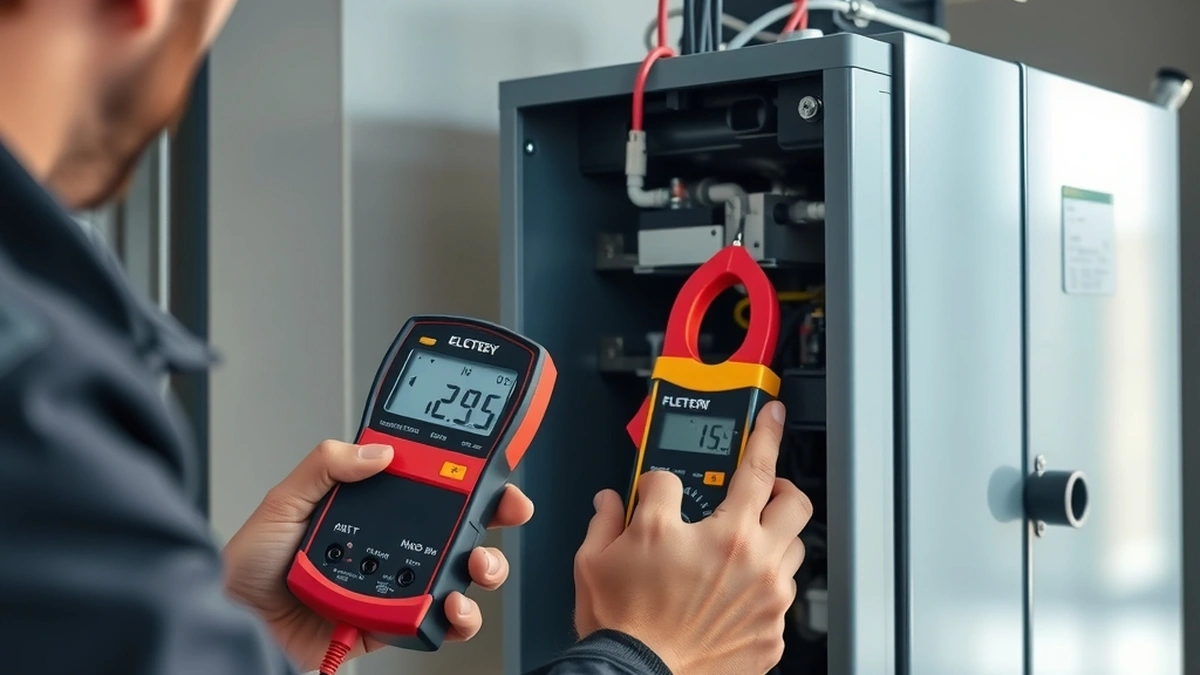
The amp draw test is the core of the trade. Each element has a rated current at 240 volts, and a clamp meter on the feed tells you whether it is working. A 5-kilowatt element draws about 20.8 amps: 5,000 W ÷ 240 V = 20.8 A. If the clamp reads zero while the sequencer is closed, the element or its circuit is open.
Breakers, elements, and the amp test
A breaker that trips only when the second or third stage comes on is telling you which element is faulty. A breaker that trips immediately points to a short or a wiring fault.
Elements fail in two ways. The coil can break, which opens the circuit and produces no heat from that stage. Or the insulation can fail and the element shorts to the casing, which trips the breaker or energizes the cabinet. The second is the dangerous one, and it is why a metallic case should never be assumed dead.
Loose lugs are the quiet third cause. High current through a loose connection generates heat at the terminal, and the damage is often at the breaker or the element block rather than in the middle of the wire. Torquing to the panel label is part of the repair.
Sequencers, limits, and blowers
The sequencer is a thermal or electronic switch that brings the elements on in sequence. It exists because a 15-kilowatt furnace starting all at once can trip a breaker that is correctly sized for the running load.
When a sequencer sticks closed, one stage runs continuously and the house overheats. When it sticks open, the blower may run with no heat at all. The part is inexpensive, and the diagnosis is voltage at the sequencer output when the thermostat calls.
The limit switch is the safety device that opens when the cabinet overheats, usually because airflow is restricted. A limit that trips repeatedly is not a limit problem; it is an airflow problem. Replacing the switch without fixing the filter, the return, or the blower speed is how the same call happens again next month.
What the repairs cost
| Repair | Typical estimate |
|---|---|
| Heating element | $200–$450 |
| Sequencer | $180–$400 |
| Limit or fan switch | $150–$300 |
| Breaker replacement | $150–$350 |
| Blower motor | $300–$600 |
| Control board | $300–$600 |
These sit inside the $150 to $600 repair band. An emergency call-out adds $200 to $500 after hours, and a full replacement runs $3,000 to $6,500 for the electric side, or up to $8,000 for a complex job.
The repair-or-replace line is arithmetic. A $380 sequencer on a 12-year-old furnace is $380 ÷ $3,000 = 12.7 percent of the cheapest replacement, which is an easy repair. A $600 blower plus a $400 element on a 22-year-old unit is $1,000, or a third of replacement, and that is the point where the annual cost of repair starts to exceed the annual cost of a new machine.
A safe five-step check
- Turn the thermostat to heat and wait five minutes. A delay is normal; a sequencer stages the elements.
- Check the breaker at the panel and reset it once. If it trips again, stop.
- Replace the filter and confirm no return grille is blocked. Airflow faults mimic electrical faults.
- Check the service switch beside the furnace, which is often mistaken for a light switch.
- Look at the fault light on the control board if there is one, and write down the code.
Do not remove the element cover with the breaker on, and do not test an element by touching it. The circuit is 240 volts and the current is lethal.
Electric against gas failure modes
An electric furnace has no igniter, flame sensor, pressure switch, inducer, gas valve, or heat exchanger, so those repairs do not exist. Its failures are elements, sequencers, limits, breakers, and blowers. A gas furnace has more safety devices and a venting system to maintain, but its repairs cluster in the same $150 to $600 band. Our gas furnace problems guide covers the other list.
If the repair quote is approaching replacement, the electric furnace cost guide has the line items, and the electric versus gas comparison covers whether switching fuel is worth the change.
Frequently asked questions
Why is my electric furnace blowing cold air?
The blower is running but the elements are not. A failed element, an open limit switch, a stuck sequencer, or a tripped breaker will all produce that symptom, and the amp draw test identifies which one.
Why does my electric furnace trip the breaker?
A shorted element, a failing blower motor, a loose connection, or a breaker undersized for the nameplate. Elements can fail to ground and trip only when that stage energizes, which makes the fault intermittent.
How do I know if a heating element is bad?
A technician measures resistance and amp draw with the element energized. A visual check can show a broken coil, but an element can look intact and still draw no current, so the meter decides.
What does an electric furnace sequencer do?
It stages the elements on and off with a delay so the panel does not see the full inrush at once. A stuck sequencer can leave one stage on continuously, or prevent any stage from coming on.
Is it worth repairing a 20-year-old electric furnace?
Often yes, because the machine is simple and parts are inexpensive. Compare the quote to replacement: a repair above about a third of three thousand dollars on a unit past 20 years is usually not worth it.
Can I replace a heating element myself?
The part is accessible, but the circuit is 240 volts and the element draws high current. Unless you can isolate and lock off the breaker and work to code, this is licensed electrical work in most jurisdictions.
Sources
Some links are affiliate links.If you buy through them we may earn a commission at no extra cost to you. We do not accept payment for rankings. Read the full disclosure.