Heat pump problems: seven faults and how to diagnose them
Most heat pump problems trace to airflow, refrigerant charge, or a failed sensor. Here is how to identify each fault and what the repair typically involves.
Most heat pump problems come down to restricted airflow, low refrigerant charge, a failed sensor or board, or a blocked condensate drain. Diagnose the symptom first, because the same complaint can come from four different faults.
- Diagnostic service call
- $100–$250
- Emergency call-out
- $200–$500
- Replacement system
- $5,000–$12,000
- Furnace repair comparison
- $150–$600
Some links on this page are affiliate links.If you buy through them we may earn a commission at no extra cost to you. We do not accept payment for rankings. Read the full disclosure.
Most heat pump problems trace to one of four causes: restricted airflow, incorrect refrigerant charge, a failed electrical component, or a control fault. The symptom rarely names the cause on its own. Cold air in heating mode can mean a stuck reversing valve, a thermostat in the wrong mode, or a system still in defrost.
Diagnosis is therefore a sequence, not a guess. Work from the cheapest and safest checks toward the ones that need gauges and a meter.
What counts as a heat pump problem
A heat pump problem is any fault that stops the system moving heat at its rated capacity — whether that shows up as no heating, no cooling, short cycling, noise, ice, or water on the floor. Many of them are the same fault wearing different symptoms.
The appliance has more moving parts than a furnace: a reversing valve, a defrost control, an outdoor fan, and a compressor that runs in all seasons. That is why the fault list is longer, and why the annual service matters more.
The seven common faults
The list below is ordered by how often each appears, and by how cheap it is to rule out.
| Symptom | Most likely cause | Typical repair |
|---|---|---|
| No heat, fan running | Reversing valve stuck, thermostat mode | Valve or control board |
| Weak heat | Low refrigerant charge, dirty filter | Leak repair and recharge |
| Solid ice on outdoor unit | Defrost board, fan motor, low charge | Board or motor replacement |
| Short cycling | Oversized system, blocked airflow, bad sensor | Duct work or sensor |
| Water around air handler | Blocked condensate drain, failed pan | Drain clearing, pan repair |
| Loud hum or rattle | Loose panel, failing contactor, debris | Panel, contactor, cleaning |
| Tripping breaker | Compressor fault, shorted wiring, weak breaker | Diagnosis required first |
Repair prices vary by market. A diagnostic visit typically runs $100 to $250, and most single-component repairs add an estimated $150 to $600 in parts and labour. Those are estimates, not quotes.
Fault one: airflow restriction
The cheapest fault and the most common. A clogged filter, a collapsed flex duct, or a closed register cuts airflow, which drops capacity and can freeze the indoor coil in cooling mode.
Change the filter and check every return grille before paying anyone. If the filter is clean and the airflow is still weak, the duct system needs measuring rather than guessing.
Fault two: refrigerant charge
A system that is undercharged has a leak. Adding refrigerant without finding the leak is a temporary fix that repeats every season.
Symptoms are weak heating or cooling, a frosted suction line, and a compressor that runs long cycles without reaching setpoint. A technician confirms with superheat and subcooling readings, then pressure-tests to locate the leak.
Fault three: the defrost cycle
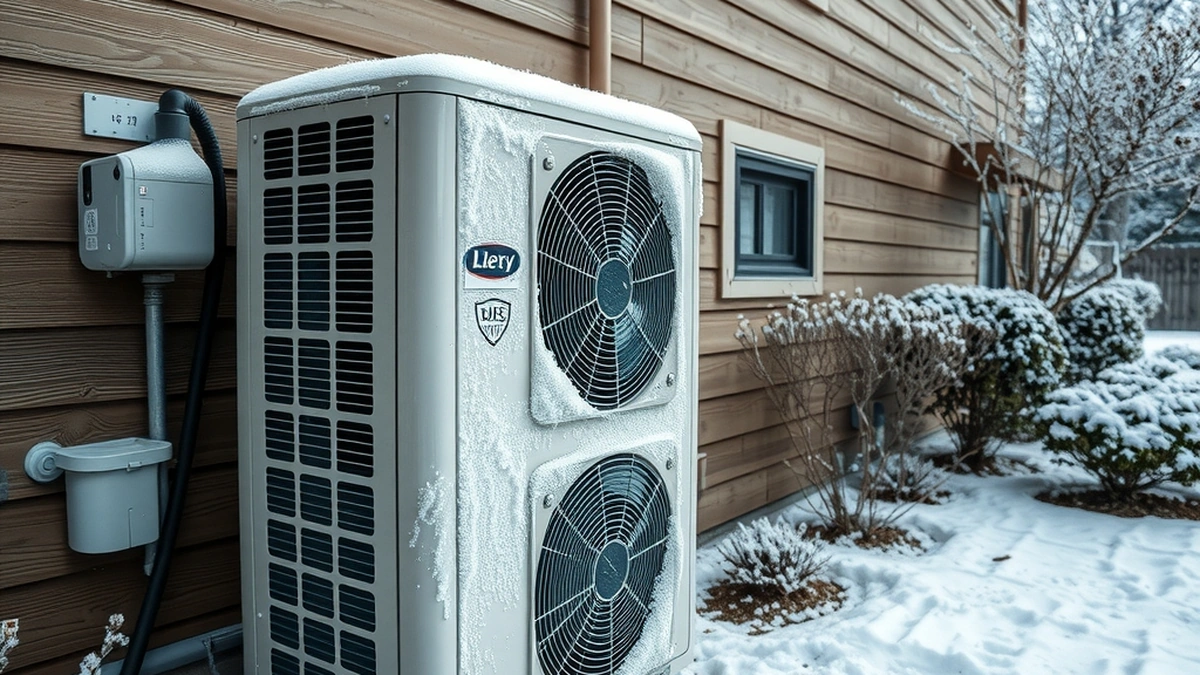
In heating mode the outdoor coil gets cold enough to collect frost. The defrost control periodically reverses the cycle to melt it. When that control fails, the coil ices into a solid block and airflow stops.
Light frost that clears every 30 to 90 minutes is normal. Ice that survives for hours, or ice that reaches the fan blades, is not.
Fault four: the reversing valve
The reversing valve is what makes a heat pump a heat pump. A valve stuck in cooling mode means the system blows cold air in winter while the outdoor unit runs normally.
This is a sealed-system component. Replacement is a brazing job with refrigerant recovery, so it is one of the more expensive repairs on the list.
Diagnose before you call
- Confirm the thermostat mode and setpoint. A system in cooling mode will blow cold air in January, and this happens more often than anyone admits.
- Replace the filter. Note the size and write the change date on the frame.
- Look at the outdoor unit. Clear leaves and snow from the sides, and check whether the fan turns freely with the power off.
- Check the breaker and the float switch. A tripped breaker or a condensate float that has shut the system down looks identical to a dead unit.
- Write down the symptom, the timing, and the outdoor temperature. That three-line note shortens the service call and often saves the diagnostic fee.
Heat pump faults against furnace faults
| Heat pump | Gas furnace | |
|---|---|---|
| Typical repair | $150–$600 | $150–$600 |
| Most common fault | Airflow, charge, sensors | Igniter, flame sensor, pressure switch |
| Seasonal risk | Defrost and ice in winter | Heat exchanger cracks with age |
| Safety issue to watch | Refrigerant leak | Carbon monoxide |
The repair prices are similar. What differs is the failure mode. Furnace faults tend to be discrete components that either work or do not; heat pump faults often degrade performance gradually, which is why an annual service catches them earlier. Our furnace fault list covers the combustion side.
When to call it an emergency
Call after hours when the house is below 60 degrees Fahrenheit with vulnerable occupants, when there is a burning smell, when water is actively flooding the mechanical space, or when the breaker trips repeatedly. An emergency call-out runs $200 to $500, roughly double a scheduled diagnostic.
Everything else can wait for a weekday appointment. A noisy outdoor fan or a system that heats poorly but still heats is uncomfortable, not urgent.
Repair or replace
The arithmetic is simple. If the unit is 16 years old, a $900 repair buys perhaps four more years at $225 per year. A $5,000 to $12,000 replacement spread across 18 years is $278 to $667 per year before any efficiency gain. Repair wins on pure cost until the repair approaches a third of replacement.
Replace instead when the compressor or the indoor coil has failed on an old unit, when the repair quote passes about $2,500, or when the same fault has returned twice in two seasons.
Most of this is preventable
Clean filters, a clear outdoor unit, and one professional visit a year remove a large share of these faults before they start. The maintenance schedule lists what that visit should include, and the installation guide explains why a commissioning report prevents a whole category of charge and airflow complaints. If you are weighing the technology itself, the heat pump cost breakdown puts the numbers side by side with a furnace.
Frequently asked questions
Why is my heat pump blowing cold air in heating mode?
Usually a reversing valve that has not switched, a defrost cycle running, or a thermostat configured for cooling. Check the mode setting and the outdoor unit first, then call for service.
Why does my heat pump freeze up in winter?
Some frost is normal and the defrost cycle clears it. A solid block of ice that persists for hours points to a failed defrost board, a bad outdoor fan motor, or low refrigerant.
How much does heat pump repair cost?
Diagnostics typically run one hundred to two hundred fifty dollars, and a common repair such as a capacitor, contactor, or sensor usually adds one hundred fifty to six hundred dollars in parts and labour. Estimates vary by market.
Why is my heat pump so noisy?
A hum or rattle often means a loose panel, a failing contactor, or debris in the outdoor unit. A grinding compressor or a screeching fan bearing needs a technician rather than a screwdriver.
Can I repair a heat pump myself?
You can safely change filters, clear the outdoor unit, reset breakers, and check the thermostat. Refrigerant work, electrical diagnostics inside the cabinet, and compressor replacement require licensed tools and certification.
When should I replace rather than repair a heat pump?
When the unit is past fifteen years, the repair exceeds a third of replacement cost, or the compressor or coil has failed. Below those thresholds, repair usually wins on cost per year of remaining life.
Sources
Some links are affiliate links.If you buy through them we may earn a commission at no extra cost to you. We do not accept payment for rankings. Read the full disclosure.