No heat: repair options when the furnace will not run
Four faults cause most no-heat calls, and two of them are safe to check yourself. Here is the triage order, what each repair costs, and when to replace.
Most no-heat calls come down to a thermostat that is not calling, a tripped breaker or float switch, a dirty flame sensor, or a failed igniter. Typical repairs run $150 to $600, and the technician's diagnostic visit is usually credited against the work.
- Typical repair
- $150 - $600
- Emergency call-out
- $200 - $500
- Replacement
- $3,000 - $8,000
- Tune-up
- $100 - $250
Some links on this page are affiliate links.If you buy through them we may earn a commission at no extra cost to you. We do not accept payment for rankings. Read the full disclosure.
When a furnace produces no heat, the fault is usually one of six things: the thermostat is not calling, power is interrupted, airflow is blocked, the flame sensor is dirty, the igniter has failed, or a safety switch has tripped. Two of those are safe to check yourself in ten minutes. The rest need a meter and a service manual, which is what the $150 to $600 repair band mostly pays for.
A no-heat call means either the furnace runs without producing heat or it does not start at all. Separating those two cases before you call saves time and often money, because “runs but cold” and “dead” lead to different fault lists.
First, split the problem in two
Stand at the furnace with the thermostat calling for heat and listen.
- Burner lights, then shuts off after 5 to 15 seconds. The flame sensor is not proving flame. This is the most common no-heat fault in a modern furnace.
- No flame, but the inducer fan runs and you hear clicking. The igniter is trying and failing.
- Nothing happens at all. Power, thermostat, or a safety switch.
- Blower runs, burner never lights. Pressure switch, gas valve, or a blocked flue.
- Burner lights, no air from registers. Blower motor or a limit switch that has tripped.
Each of those points at a different part, and the part prices differ by hundreds of dollars.
The faults behind most no-heat calls
| Fault | What you notice | Typical repair |
|---|---|---|
| Dirty flame sensor | Lights, runs a few seconds, shuts off | $150 - $250 |
| Failed hot-surface igniter | Clicking, no flame, lockout | $150 - $300 |
| Thermostat or wiring | No call for heat at all | $100 - $250 |
| Tripped float switch | Shuts down in wet weather | $150 - $300 |
| Pressure switch or blocked flue | Inducer runs, no ignition | $200 - $500 |
| Gas valve | No flame, no gas at the burner | $350 - $650 |
| Control board | No sequence, fan not starting | $400 - $800 |
| Blower motor | Heat but no airflow | $450 - $900 |
Most of that table sits inside the $150 to $600 band that covers the majority of furnace repairs. The bottom three rows are the exceptions, and they are also the point where repair-or-replace arithmetic starts to matter.
What the technician will actually test
A competent diagnostic follows the ignition sequence rather than replacing parts until the furnace lights.
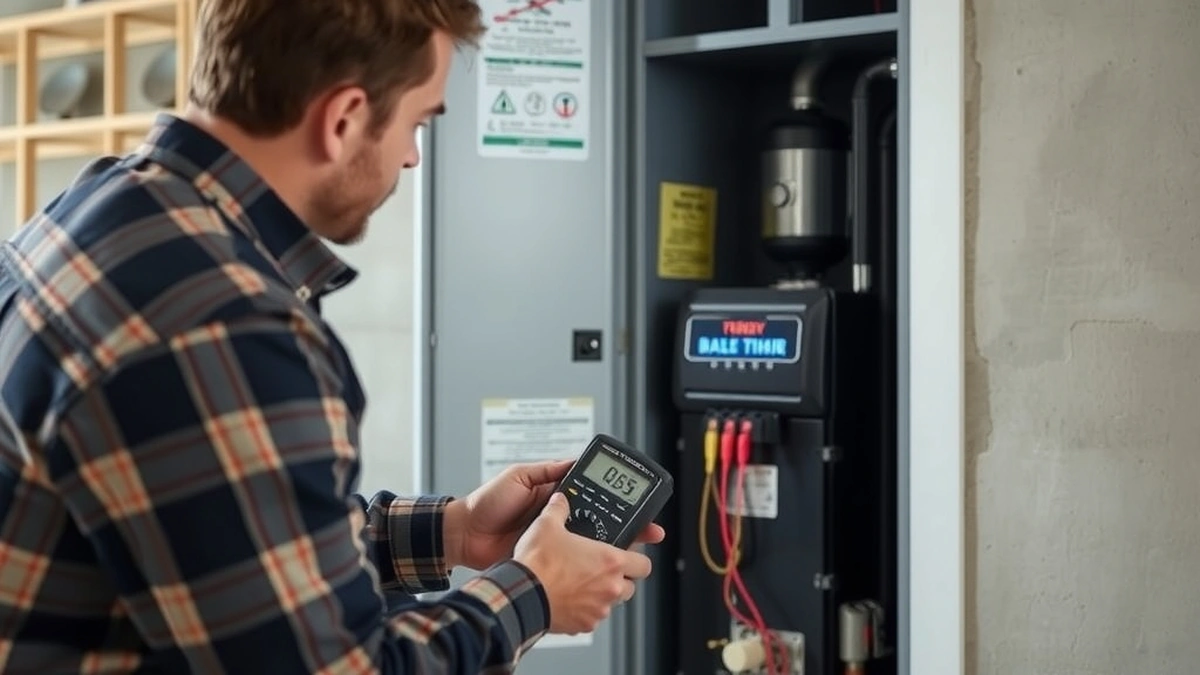
- Confirm the call. Thermostat voltage at the control board, usually 24 volts on R and W.
- Check the safety chain. Pressure switch, rollout switch, and limit switch in series; the first open switch stops everything downstream.
- Watch the ignition sequence. Inducer starts, pressure switch proves, igniter heats, gas valve opens, flame proves.
- Measure flame signal. A microamp reading below the manufacturer’s threshold means a dirty or failing sensor.
- Check gas pressure and temperature rise. Inlet and manifold pressure against the data plate, and a rise inside the stated range.
Ask which of those five steps produced the diagnosis. “The board is bad” without a voltage check is a guess, and boards are the most commonly misdiagnosed part in residential heating.
What you can safely handle
These are homeowner tasks, and none of them involve gas or a sealed combustion path:
- Thermostat. Fresh batteries, correct mode, setpoint above room temperature, and the fan switch on auto rather than off.
- Breaker and service switch. The furnace has its own breaker and often a light-switch-style service switch at the unit. Both get knocked off.
- Filter. A filter clogged solid can trip the high-limit switch and shut the burner down.
- Gas shutoff valve. Confirm the handle is parallel to the pipe, not across it. A contractor may have left it closed after service.
- Condensate. A high-efficiency furnace has a float switch that shuts the unit down when the drain backs up.
If those five are correct and the furnace still will not heat, the next step is a technician, not a parts order.
What you should not touch
- Gas piping and the valve train. Leak testing and pressure adjustment need a licence and a manometer.
- The heat exchanger. A cracked exchanger can put combustion products into the supply air. It is a carbon monoxide risk, not a performance issue.
- Flue and venting. A blocked or incorrectly sloped flue is a safety fault, and the furnace’s safety switches are the only thing standing between it and the room.
- Anything behind a sealed combustion door on a condensing furnace.
If a carbon monoxide alarm sounds, leave the house and call the fire department or gas utility from outside. That is not a repair call.
Repair options, and when replacement wins
The decision has a simple test: if the repair costs more than about a third of replacement, or the heat exchanger has failed, replace. $3,000 to $8,000 buys a new furnace installed; a $900 blower motor on a twenty-year-old unit does not buy another decade.
Run the annual arithmetic. A $600 repair that buys three more years costs $200 per year. A $5,500 replacement over eighteen years costs $306 per year, with a warranty and lower fuel use. On a unit past fifteen years with a second fault behind the first, replacement is usually the cheaper path per year of service.
Before you approve anything, ask two questions: what is the total including the diagnostic, and what is the expected life of the part being replaced. Our guide to what a fix costs breaks the arithmetic down by fault, and the warning signs guide covers the failures that announce themselves before the house goes cold.
If the furnace is short cycling rather than dead, that is a different diagnosis — start with short cycling repair. And if you are weighing a heat pump against another furnace, the heat pump comparison sets out the numbers for a $5,000 to $12,000 installation.
Frequently asked questions
Why is my furnace running but not heating?
The burner is not lighting or the flame is shutting off. The usual causes are a dirty flame sensor, a failed igniter, a pressure switch that never closes, or a gas valve that is not opening.
What should I check before calling a technician?
Thermostat mode and setpoint, the breaker at the panel, the service switch at the furnace, the filter, and the gas shutoff valve. Those five account for a meaningful share of no-heat calls.
How much does a no-heat repair cost?
Most repairs land between $150 and $600 including the diagnostic. Control boards, blower motors, and inducer assemblies go above that band, so ask for a quote before approving.
Is it safe to relight a pilot light myself?
Only on an older standing-pilot furnace, following the label inside the door. If you smell gas, do not light anything; leave the house and call the gas utility from outside.
How long should a furnace last?
Fifteen to twenty years with annual service. Past twenty, a major repair is usually better spent on replacement, especially if a second fault is likely.
Should I repair or replace a 20-year-old furnace?
If the repair exceeds about a third of replacement cost, or the heat exchanger has failed, replace it. A $3,000 to $8,000 replacement buys fifteen or more years; a $900 repair on a 20-year-old unit buys far fewer.
Sources
Some links are affiliate links.If you buy through them we may earn a commission at no extra cost to you. We do not accept payment for rankings. Read the full disclosure.