Thermostat not responding: repair options
Six reasons a thermostat stops responding, the fix for each, and how to tell a dead battery from a dead control board before you pay for either.
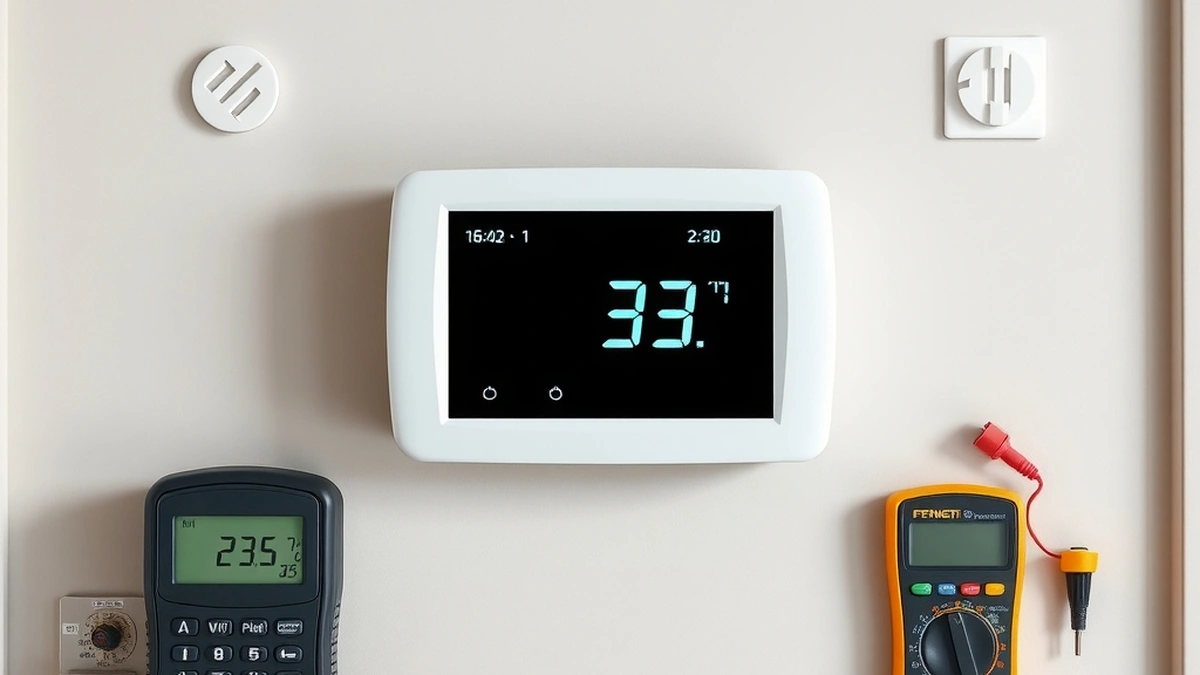
A thermostat that does not respond is usually a dead battery, a tripped furnace switch, a blown fuse on the control board, or a wiring fault. Repairs run $150 to $600, a thermostat replacement $150 to $400, and the diagnostic visit $100 to $250.
- Thermostat replacement
- $150 - $400
- Diagnostic visit
- $100 - $250
- Wiring repair
- $150 - $400
- Control board
- $300 - $600
Some links on this page are affiliate links.If you buy through them we may earn a commission at no extra cost to you. We do not accept payment for rankings. Read the full disclosure.
A thermostat that does not respond is usually not a thermostat problem. Dead batteries, a furnace service switch that was knocked off, a blown 3-amp fuse on the control board, or a broken wire at the wall plate account for most cases. Repairs run $150 to $600, a thermostat replacement $150 to $400, and the diagnostic $100 to $250. Checking three things yourself costs nothing.
What the thermostat actually does
A thermostat is a switch with a thermometer. It closes a circuit to call for heat, and it opens it when the setpoint is reached.
That simplicity explains the failure pattern. The thermostat has no moving parts beyond a relay, and the relay is usually the last thing to fail. What fails more often is the power supply to it, the wire between it and the furnace, or the furnace’s own control circuit.
So before replacing a thermostat, confirm it has power and that the furnace is willing to run.
The six causes
| Cause | Symptom | Fix | Cost |
|---|---|---|---|
| Dead batteries | Blank screen, no response | Replace batteries | $5 - $15 |
| Furnace switch off | Thermostat fine, no response | Turn the switch on | $0 |
| Blown board fuse | No 24V at thermostat | Replace fuse | $100 - $250 |
| Broken or loose wire | Intermittent or no call | Repair or re-terminate | $150 - $400 |
| Failed thermostat | Powered but no call | Replace thermostat | $150 - $400 |
| Control board fault | No 24V output | Replace board | $300 - $600 |
Four of the six are cheap. The order of checking matters more than the diagnosis itself.
The three checks to do first
Before booking anyone:
- Replace the batteries. On a battery-powered thermostat this resolves a large share of blank-screen calls, and it costs a few dollars.
- Find the furnace service switch. It is usually a light-switch-style toggle on or near the furnace, often at the top of the basement stairs. Someone may have switched it off.
- Check the breaker at the panel, and reset it once if it is tripped.
If the thermostat comes back to life after those three, you have saved a service call. If it does not, you have narrowed the problem.
Reading the symptoms
Blank screen. Battery or 24-volt power. On a hard-wired model, no display usually means no power from the furnace, which points at the fuse, the transformer or the board.
Display works, no response. The thermostat is powered and possibly clicking. The fault is downstream: furnace switch, limit switch, pressure switch, or board.
Display flickers. Loose wire at the wall plate, or a failing transformer. Both are a service call.
Heating runs constantly. A stuck relay in the thermostat or a welded contact on the board. Switch the furnace off at the breaker while you wait for service.
“No power” or “C-wire” warning on a smart thermostat. The unit needs a common wire it does not have. A C-wire run is $150 to $300 and is the usual fix.
Wiring and the C-wire problem
Smart thermostats need a constant 24-volt supply, which older four-wire installations do not provide. Without it, the unit borrows power through the heating or cooling call and behaves erratically — dim display, dropped Wi-Fi, or a furnace that short cycles.
Three options:
- Run a new C-wire from the furnace to the thermostat, $150 to $300.
- Use an adapter module at the furnace, $100 to $200 installed, which is often adequate.
- Choose a thermostat that does not need a C-wire, which is the cheapest and least capable option.
An installer who fits a smart thermostat on a four-wire system without addressing this is setting up a callback.
Repair or replace the thermostat
Thermostats are inexpensive and rarely worth repairing.
| Situation | Recommendation |
|---|---|
| Basic unit, over 10 years, failed | Replace at $150 - $300 |
| Smart unit under warranty | Claim warranty, replace |
| Wiring fault only | Repair wiring at $150 - $400 |
| Furnace board fault | Repair board at $300 - $600 |
A $300 board repair on a $40 thermostat is not a comparison — the board is in the furnace, not the thermostat. Keep the two separate when a quote arrives.
What the diagnostic should include
A proper thermostat diagnosis at $100 to $250 measures rather than guesses:
- 24-volt supply at the thermostat terminals.
- Continuity of each conductor in the thermostat cable.
- Thermostat call output with a jumper test.
- Furnace response at the board terminals.
- Fuse and transformer condition.
Item four is what separates a thermostat fault from a furnace fault, and it takes five minutes with a meter. A technician who replaces the thermostat without it is guessing at your expense.
What to do next
- Replace the batteries and check the display.
- Check the furnace switch and breaker.
- Note whether the thermostat clicks when it calls.
- Book a diagnostic at $100 to $250 if it still does not respond.
- Ask for the 24-volt reading at the thermostat.
- Fix the C-wire if a smart thermostat is dropping offline.
The pricing detail is in thermostat not responding cost, and the prevention measures are in thermostat not responding prevention. For the symptoms that precede a full failure, see thermostat not responding warning signs, and if the thermostat is calling but the furnace is silent, no heat repair is the closer guide.
Blank screen means power. Working screen with no response means the furnace. Clicking with no ignition means downstream.
Those three sentences resolve most thermostat calls before anyone opens a toolbox, and the first two checks cost nothing at all. One more thing worth checking before the van arrives: whether the thermostat is on a wall that gets afternoon sun. A unit reading a sun-warmed wall will stop calling for heat while the room is still cold, and the symptom looks like a failed thermostat. Moving the setpoint a degree or two higher in the afternoon and watching whether the furnace responds is a free test that separates a placement problem from a hardware fault.
Frequently asked questions
Why is my thermostat screen blank?
Most often dead batteries on a battery-powered model, or no 24-volt power from the furnace on a hard-wired one. Check the furnace switch and breaker before assuming the thermostat has failed.
How do I know if the thermostat or the furnace is the problem?
If the thermostat has power and displays settings but the furnace does not respond, the fault may be at the furnace. If the thermostat is blank or unresponsive, start there. A diagnostic at $100 to $250 confirms it.
Can a thermostat be repaired or does it need replacing?
Battery models are usually replaced. Wiring faults and blown fuses on the furnace board are repaired at $150 to $400. A thermostat itself is $150 to $400 installed, and it is rarely worth repairing.
Why does my thermostat click but nothing happens?
The click is the relay closing, which means the thermostat is calling. If the furnace does not start, the fault is downstream — a furnace switch, a fuse, a limit switch or the control board.
Do smart thermostats fail more often?
They fail differently. The common issues are Wi-Fi connection loss, firmware faults and a C-wire that was never installed, rather than the simple battery and relay faults of a basic unit.
How much does it cost to replace a thermostat?
Typically $150 to $400 installed for a standard programmable unit, and $250 to $500 for a smart thermostat with a C-wire run. The diagnostic is separate at $100 to $250.
Sources
Some links are affiliate links.If you buy through them we may earn a commission at no extra cost to you. We do not accept payment for rankings. Read the full disclosure.