What Does AFUE Mean on a Furnace?
AFUE is the share of fuel a furnace turns into heat over a year. Learn what 80% and 95% mean, venting needs, and how to compare installation quotes.
Data checked November 2026 · Sources: manufacturer installation manuals; AHRI efficiency directory; NFPA 54 as locally adopted; local mechanical permit offices ·Methodology →
AFUE stands for annual fuel utilization efficiency, measuring the percentage of fuel energy converted into usable space heat over a heating season. An 80% furnace loses about 20 units of heat per 100 burned, while a 95% model uses roughly 16% less fuel for the same heat.
- Standard efficiency
- 80% AFUE
- High efficiency
- 95% AFUE
- Fuel reduction
- Roughly 16% less gas
- Equipment cost
- $3,000–$8,000 replacement
Some links on this page are affiliate links.If you buy through them we may earn a commission at no extra cost to you. We do not accept payment for rankings. Read the full disclosure.
| 80% AFUE Furnace | 95% AFUE Furnace | |
|---|---|---|
| Fuel consumption | Consumes 100 units of gas for 80 units of heat | Consumes 84.2 units of gas for 80 units of heat |
| Venting material | Standard metal flue pipe | Dedicated PVC exhaust and intake pipes |
| Byproduct handling | Dry exhaust gases exit chimney | Produces acidic condensate requiring drainage |
| Relative fuel usage | Baseline operating consumption | Roughly 16% less fuel for equal heat |
AFUE is the annual fuel utilization efficiency metric that measures how effectively a residential furnace converts gas into usable space heat over an entire heating season. While the yellow EnergyGuide label displays this percentage on cabinets, understanding the numbers helps homeowners select heating systems matching their infrastructure and budget.
The definition of furnace AFUE
AFUE is an annualized metric that reflects the percentage of fuel energy converted into discharged space heat during typical seasonal cycles. An 80% AFUE furnace extracts 80 units of heat from every 100 units of gas consumed, venting the remaining 20 units outdoors through the chimney system as residual thermal exhaust.
The measurement evaluates cyclic operation rather than continuous burner firing. Unlike steady-state combustion efficiency, which evaluates burner performance at peak operating temperature, annual utilization includes heat lost as burners cycle on and off. It accounts for thermal energy escaping through cabinet walls and chimneys, providing an accurate indicator of seasonal fuel consumption.
How laboratory efficiency testing works
Standardized laboratory procedures determine AFUE by cycling equipment through simulated winter demand profiles rather than measuring steady-state combustion continuously. Test conditions assume baseline sea-level atmospheric pressure, stable fuel chemistry, and fixed indoor airflow rates to generate an objective comparative benchmark across diverse equipment manufacturers and mechanical designs.
Testing occurs within controlled indoor environments using uniform fuel sources and calibrated electrical inputs. Technicians mount equipment according to manufacturer guidelines and cycle burners repeatedly. These standard sequences capture cycling fluctuations, jacket heat losses, and off-cycle drafts under consistent conditions, allowing buyers to compare competing platforms objectively.
Field installations encounter environmental differences that alter operating characteristics. Altitude derating applies above roughly 2,000 ft because thinner atmospheric density provides less oxygen for combustion, necessitating burner adjustments. Local utility gas composition also varies from laboratory test mixtures. Consequently, factory ratings serve as comparison tools rather than absolute operating promises.
Fuel consumption differences between 80% and 95% models
Upgrading from an 80% to a 95% AFUE furnace reduces fuel consumption by roughly 16% for an equivalent volume of delivered warmth. Delivering 80 units of heat through a 95% efficient appliance requires dividing 80 by 0.95, which totals 84.2 units of fuel instead of the standard 100 units.
| Efficiency Metric | 80% AFUE Furnace | 95% AFUE Furnace |
|---|---|---|
| Fuel for 80 heat units | 100 units of gas | 84.2 units of gas |
| Flue heat loss | 20 units of heat | 5 units of heat |
| Vent material | Metal flue | PVC pipe |
| Exhaust byproduct | Hot dry exhaust gas | Acidic liquid condensate |
| Fuel reduction | Baseline | Roughly 16% less fuel |
This mathematical relationship shows that efficiency improvements yield proportional fuel reductions. Moving from an 80% unit to a 95% unit removes 15 units of waste. However, total gas conserved depends entirely on heating demand. Milder climates with brief heating cycles yield modest seasonal savings compared to regions with sustained subfreezing weather.
Mechanical venting and drainage requirements
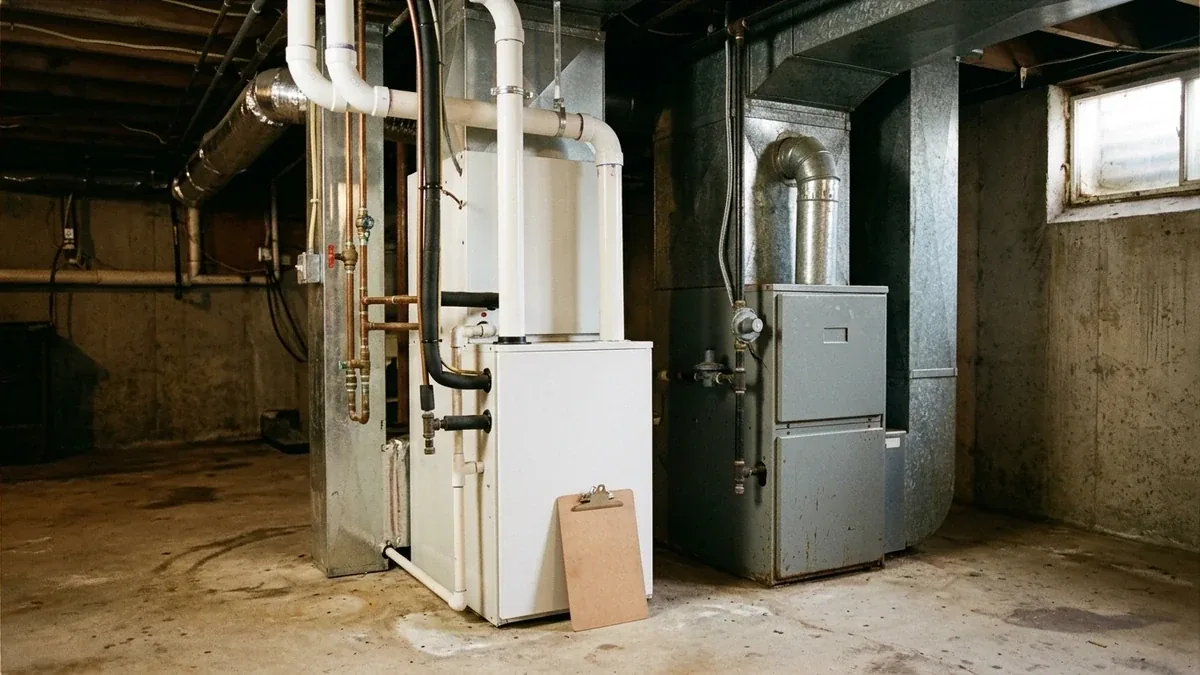
Condensing furnaces achieve elevated efficiency by routing flue gases through a secondary heat exchanger, which lowers exhaust temperatures and forms liquid moisture. Because this liquid byproduct contains dissolved acidic compounds, condensing equipment vents through plastic PVC piping and drains runoff away, unlike non-condensing units that discharge hot dry air through metal chimneys.
Standard 80% systems keep flue gases hot enough to maintain moisture in a gaseous state. Natural thermal buoyancy carries exhaust gases upward through double-wall metal B-vent pipes or masonry chimneys. This prevents condensation along exhaust surfaces, keeping flues dry and eliminating any need for dedicated drainage plumbing.
In contrast, 95% models extract latent energy by condensing moisture within a secondary heat exchanger. Because cool exhaust lacks natural buoyancy, an internal draft inducer fan pushes gases through sealed PVC piping outdoors. The resulting acidic condensate drains through plastic tubing, often requiring a neutralizer to prevent deterioration of household drainpipes.
Distribution factors omitted from the rating
The cabinet rating measures thermal conversion exclusively within the furnace cabinet, leaving external heat delivery losses unaddressed. Flaws in distribution design, uninsulated ducting runs through crawl spaces, incorrect equipment physical sizing, and restrictive air filters reduce actual home comfort while leaving the factory laboratory efficiency score completely unchanged.
Central heating depends on airtight duct channels to distribute warmed air. When ducts travel through unconditioned crawl spaces or attics, unsealed joints allow heated air to escape while drawing cold air inward. An 80% furnace connected to sealed ducts often delivers more usable heat than a 95% model attached to deteriorated ductwork.
Physical sizing errors further compromise heating results. A Manual J load calculation sizes the unit to match structural heat loss accurately. Installing an oversized furnace leads to short operational cycles that increase wear on mechanical components without warming rooms evenly. Technicians verify static pressure and temperature rise during commissioning to confirm ductwork accommodates necessary airflow.
Equipment costs for replacement and routine repairs
A full heating equipment replacement spans from $3,000–$8,000 depending on venting complexity, equipment efficiency tier, and site labor requirements. Minor operational repairs generally cost between $150–$600, whereas preventative annual servicing and safety inspections run $100–$250 to ensure heating components perform reliably within their designated mechanical parameters.
The total investment required for an upgrade depends heavily on venting alterations. Swapping an older 80% unit for a similar model typically utilizes existing metal chimney flues and gas lines. Transitioning to a 95% unit requires adding dedicated PVC piping and condensate drains. Reviewing detailed gas furnace cost data helps clarify these labor and material differences before signing a contract.
Preventative servicing preserves combustion efficiency and component longevity. A routine furnace inspection allows technicians to inspect burners, test electrical switches, and check static pressure. If home architecture makes venting difficult, comparing a gas furnace vs electric furnace provides valuable context regarding alternative heating designs before committing to wall penetrations.
Protocol for evaluating contractor proposals
Homeowners can systematically evaluate competing installation proposals by examining design documentation, verification protocols, and scope items beyond equipment brand names. Comparing detailed heating calculations, venting trajectories, and commissioning procedures ensures the selected equipment delivers its intended thermal output safely without encountering distribution bottlenecks or early mechanical failures.
- Confirm the complete equipment model number to determine if the bid specifies an 80% or 95% unit.
- Examine the proposed venting configuration to verify whether existing metal flues or new PVC pipes are planned.
- Require a Manual J load calculation to verify that equipment capacity matches the heating needs of the home.
- Confirm that static pressure and temperature rise measurements will be documented during equipment startup.
- Compare the total installed price, including piping and electrical work, rather than equipment costs alone.
Operational considerations for selecting equipment efficiency
Choosing between efficiency tiers depends on local climate severity, physical venting routes, and how long the property will be retained. High-efficiency condensing units make financial sense in colder regions with extended heating seasons, whereas milder zones may favor standard appliances to avoid expensive structural alterations for new plastic venting.
Physical layout often determines practical venting feasibility. In homes where equipment sits in finished basements far from exterior walls, drilling new routes for PVC intake and exhaust pipes involves substantial carpentry and drywall restoration. In such cases, replacing an old furnace with an 80% unit that connects to the existing chimney avoids complex remodeling costs.
Ultimately, an AFUE rating reflects equipment combustion capability rather than overall heating system performance. Ensuring airtight duct distribution, calculating accurate structural heat loads, and verifying commissioning parameters guarantees the furnace delivers its intended output. Homeowners achieve reliable long-term value by matching equipment efficiency to their specific climate conditions, physical vent paths, and distribution infrastructure.
How to do it
- Identify the equipment model numberLocate the specific model identifier on the cabinet rating plate rather than relying solely on manufacturer brand marketing.
- Review the venting configurationConfirm whether the existing chimney requires a metal flue or if new PVC pipes must penetrate exterior walls.
- Require a Manual J load calculationEnsure the contractor sizes the equipment correctly to prevent short cycling and uneven heating across rooms.
- Evaluate the distribution ductworkCheck that the supply and return ducts can handle necessary airflow without excessive static pressure restrictions.
- Verify commissioning measurementsCheck that the installer tests static pressure and temperature rise during startup to confirm proper equipment operation.
Frequently asked questions
What does AFUE mean on a heating system?
AFUE is annual fuel utilization efficiency. It represents the percentage of fuel energy converted into usable space heat across an average heating season, calculated under specific laboratory testing conditions.
How much fuel does a 95% AFUE furnace save over an 80% model?
A 95% AFUE furnace consumes roughly 16% less fuel than an 80% model to deliver the same amount of heat. It burns 84.2 units of gas compared to 100 units for the standard unit.
Does the AFUE rating account for duct heat losses?
No. The rating measures equipment combustion and heat exchanger performance alone. Leaky or uninsulated ducts in unconditioned crawl spaces or attics lower delivered heat regardless of the rating on the cabinet.
Why do 95% AFUE furnaces require PVC venting?
Condensing furnaces extract so much thermal energy that flue gases cool down and condense into acidic water. This moisture would corrode standard metal flues, requiring corrosion-resistant PVC piping instead.
How does elevation alter furnace AFUE performance?
AFUE ratings reflect sea-level factory testing. Above roughly 2,000 ft in elevation, thinner atmospheric air requires altitude derating of burner input, which reduces overall operating capacity and changes combustion parameters.
What routine maintenance preserves furnace efficiency?
An annual tune-up and safety check costing $100–$250 inspects burners, measures temperature rise, verifies static pressure, and clears condensate drainage lines to keep the heating system operating within design specifications.
Sources
Some links are affiliate links.If you buy through them we may earn a commission at no extra cost to you. We do not accept payment for rankings. Read the full disclosure.